

(Day 14 of this year’s Advent series. Yesterday’s piece was about the M.C. Escher structure of the second; today we consider negative space.)
Empty Things
Blessed are those
Who fill their time with deserts –
With empty things, stables and tombs
A mountain with crowds moved on –
The leftovers
After fishes and bread
Are gathered in.
“Negative space” is defined as “the empty space around and between the subject(s) of an image.” Its perception is the result of an eyes-plus-brain quirk that can result in optical illusions such as our previously-discussed bistable image, Rubin’s Vase.
Now: if we’re speaking philosophically here – which of course we are – there are two additional little quirky tendencies that negative space tends to bring out in humans.
Exhibit A is the tendency to focus on the subject and not see the surrounding space at all. This is the “stick a star on it” tendency of holiday preparations.
And then there’s Exhibit B. Exhibit B is…rough. For me, personally.
It’s the tendency to yes, see the negative space – and then – to make it something.
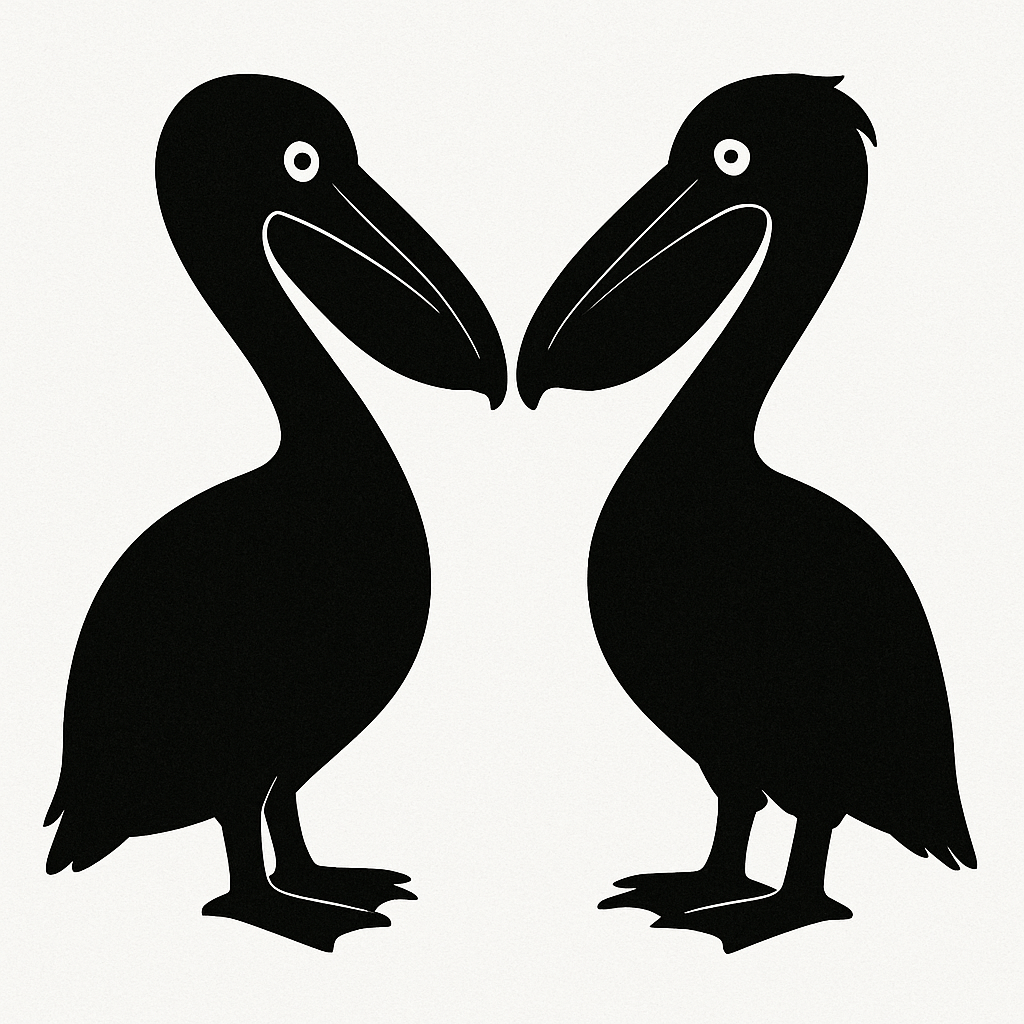
You know. Like a face, or a vase. Or two vases. Or maybe, I don’t know, a pelican. You never know where the average graphic designer is going to secretly stick a pelican into a visual?
Ok, so maybe that’s the “stick a pelican in it” tendency of looking at things. Negative space is supposed to be *checks Wikipedia again* “the empty space around and between the subject(s) of an image.”
So: the space is the space is the space.
Ok, Wikipedia. Ok. I’ll stop trying to stick a freakin’ pelican in every blessed, empty thing.
Now please tell me there are some leftovers in this empty space other than fish and bread.
 Skeleton At The Feast