
“Why so serious?” – Indeed.
We have no need
For a solemn face;
Hard truths have better taste
When Humor does the dishing.
The Time Heist

It’s a strange thing to be glad of a pickpocket, glad of a heist. I mean, of course, when you are the victim and not the perpetrator; when you willingly step up to play the fool at the carnival, or the innocent in the den of thieves. I myself wandered into such a scenario last night. In case you wondered, I lived to tell the tale.
Early yesterday evening there was no indication of the unusual events which were to occur. As reported in a non-existent local paper:
“The heist occurred between the hours of 11:30 p.m., April 14th, and 7:41 a.m., April 15th. Within this roughly eight-hour span, the victim completely lost a sense of time-related urgency and succumbed to the well-known hallucinatory effects of the game Stardew Valley, which – sources say – has recently received an update. Although the victim had previously logged several hundred hours with the game, this was the victim’s first time playing the game with the update. Authorities are investigating.”
The Imaginary Times
Yes, that was me. I stayed up all night, and I am happy to report I made it to Level 10 Fishing. I’ve never been so glad to lose my life. Well, a part of it. I suppose I lost eight hours, but it was a fair trade. Contrast this against the usual urge to flit, hummingbird-style (minus savoir faire and irate chirping) from project to project every few seconds.
It’s been quite a while since I’ve experienced that strange sensation of time slipping away with absolutely no sense of urgency. “Take your time,” said no one ever. “Go on – take it. It’s free!”
Imagine – a time-buffet. The price of entry is being born. What a strange concept: quite flawed, demonstrably untrue in practice, yet a seductively exotic luxury of which to snitch glimpses. I could argue that a lot of the more popular vices share this common motif: they alter the perception of time towards something that works for, rather than against, our delight.
Laura Vanderkam writes about this sensation of enriched time in her book Off the Clock, and argues that it can be cultivated in one’s life. It’s one thing to read about in the tidily law-abiding confines of a self-help book. It’s another thing to apply that advice in one’s own life.
But what if you are interested in more than a personal stash? What if you wish to – as it were – corner the market on high-quality enriched time? The cultivation of this illicit substance is the business of writers and other creation-workers.
To put it bluntly, it is our business to hold up our readers (viewers, users, customers, etc.) and say: “Your attention and your life.” And if we’ve done our job well, they’ll say – just for a moment – “Why, certainly.”
We are faced with the question of how to steal time and give back fulfillment. It almost sounds like a virtuous act when I phrase it that way – practically a public service.
But although many of us like to talk about truth, we aren’t completely honest. We don’t mirror life precisely; rather, we reflect back an abundance of the things usually trapped in time’s bottleneck. Love, action, wisdom, good fortune, and their inverses as well: they’re judiciously harvested, distilled, and bottled for consumption at leisure. The mix is intoxicating precisely because these experiences are so rarely available when people have the time to savor them.
If we’ve done our job well, the product of our efforts offers something that sidesteps time’s demands. It offers our targets – ah, readers – the chance to experience their humanity free from time’s constraints, for a moment or an hour or an evening.
Later, when they check their pockets and find themselves short on time, they’ll find in its stead a receipt. It reads:
“Life is held only partly in the moments it is lived. The price for expanding it is the time you didn’t think you had. Memory, contemplation, introspection, understanding: all these take place beyond time’s concern. You’re welcome – and please come again.”
Please note the header image is a screenshot of the Stardew Valley opening screen. I do not claim any rights to any part of Stardew Valley or its creator, Eric Barone. However, if you are looking for an excellent way to lose time, I dearly love that game and highly recommend it.
Peach Tree Seasons

Peach tree seasons, time run soft
And swell in hours of sun –
Unseen to shy green,
Velvet to blush-green,
An ever-asking question
Of ripening fruit.
I love discovering fruit trees. They always take me by surprise; a tree that was just a tree, until it started to grow fruit. A small part of me can never quite believe the miracle.
Earlier this spring, on my walk to my second job I would pass a fenced-in yard with a few trees poking over the fence. One day I noticed small green marbles all over a previously-unremarkable tree – peaches! Or some sort of stone fruit. Each week they grew a bit more, a very old story. I developed the habit of marking time by the peaches’ growth.
I haven’t walked that way since mid-March, when the workplace closed for shelter-in-place.
Related: Peach Tree Memory
If a thousand and one terrors that seem to befall fruit trees haven’t gotten them yet – those peaches are still growing. I like to think they’re getting up to all sorts of trouble in my absence. Perhaps later today I’ll walk that way to find out. In the meantime, I have my peach-flavored tea to enjoy, and dreams of peaches changing sunshine into sugar.
Today is Earth Day, They Say

Today is Earth Day, they say? –
World in a day.
I don’t understand; never mind the world. Even the word doesn’t stay
contained. Earth: close your eyes.
Deep brown secrets, flaming stone. Blue of a planet framed
In void – clouds, monsoon, cycles and sex: miracle and molecule aligned,
Combined.
Darkness on a moon, phosphorescence on the tides.
Shoals, eggs, turning, and time for the long-drawn question of life –
Celebrate? Propagate.
Chlorophyll, single-cell, vertebrate:
This honor is fractal, yet means one thing.
Let the words of my mouth and the meditations of my heart
Not destroy what my mind can’t comprehend.
Peach Tree Memory
A cup of peach tea – memory:
Earlier this year, I saw a peach tree.
Week by week, the peaches grew;
Morning by sunrise, I knew
Change: a soft surprise
Glimpsed through chlorophyll eyes.
Cocoon

Cocoon,
For what I cannot say.
Some strange fierce beast
May yet emerge,
Undreamt of in philosophy,
Unspoken in our time.
No polite creature,
It didn’t wait for conception.
No act of patient creation
Or standing in time.
It stretched, and grew,
Composite and whole,
Though the eyes that see can’t tell:
It yawned, and, looking out,
asked its riddle.
Today – They Mowed The Grass

Today – they mowed the grass.
– Alas!
The jungle is vanished; the leaf-temples
Subject to expedition,
Have given up their mystery air.
No more, the emerald; no more, altars where
Unimaginable rites were –
…Imagined.
All this lies shattered, buried
Piles of grass and topiary
Of doom. Tomorrow –
The hunter-gatherers move in.
And you can bet I’ll be surveying their campfires through my binoculars. From the safety of the balcony.
Going Slow
My definition of a good day is simple: it’s a day when time moves at the right speed.
“The right speed” means not too fast over the good parts, nor too slow over the parts that I would skip if I could. Everything is simply in the right time in the right place. This is how an ordinary day becomes perfect.
Conversely, pretty much any great life crisis is linked to time becoming singularly uncooperative. It’s those moments when life forces you to move at a different speed than you envisioned; nearly always slower, or (in less common cases) more quickly, but in a direction you would not have voluntarily chosen.
I recently joined one of my more charmingly mischievous coworkers in an effort to explain to another grocery store coworker – half teasing – how to work slowly. Take your time, we said: what’s the rush? Smile at everyone, lean against the counter, carefully dust the same spot for ten minutes or more. Saunter to get water, multiple times a day. Double-check your password, your online training statuses, your schedule and your timecard. Relish the small tasks that can be repeated ad infinitum with complete ingenuousness.
To clarify, this would not be my normal advice. It is evidence of the sheer unprecedented nature of our time (read: pandemic) that I was advising what under normal circumstances (alright, the dictionary definition) would be considered “dawdling.” And the coworker to whom we spoke is notorious for doing her work in record time, as she has all her life. She has worked in food services since around age 16, and she is now around age 71. If I asked her the meaning of the word “slack,” I am confident she would throw something heavy at me.
But this coworker’s normal workplace routine is currently not applicable. She is, currently, not allowed out on the grocery store floor, because she is elderly and at heightened risk from Covid-19. She also cannot afford to lose pay from being sent home early, as she might if a manager noticed she had run out of things to do. It’s the proverbial rock and a hard place (coupled with a stubborn and spicy temper). So we coaxed and cajoled her to go slow. But the main problem with going slow, it turns out, is that she is determined not to be “a slow person”.
Have you noticed? So much of our identity is linked to the speed at which we live our life.
As Death in the Sandman comics says, “You get what everyone gets; you get a lifetime.” In the face of infinity, it doesn’t matter if you’re “slow” or “live in the fast lane.” It doesn’t matter if you made the “30 under 30” list. It doesn’t even matter if you have time to develop all your ideas, finish all your projects, do what you came to do; you almost certainly won’t.
I’m not going to tell you to slow down, or make peace with your life. I couldn’t do either of those things if my life depended on it. If you can’t pay attention to today because your head is stuck in yesterday or tomorrow, that’s your business, and I wish you the best. But for Heaven’s sake – don’t do it because you feel you need to be “the sort of person who…” lives your life at a speed anything other than your own.
Amulet for the Everyday
I’m bad at reassurance. I’d say hang in there, but I don’t want to tell you what to do. I don’t want to burden you with survival, that yoke of expectations that will likely turn out not to be true.
Besides, I have something to give you that’s better than reassurance. It’s a small thing and sometimes rests easy when worn correctly; you’ll find it makes its own weight. Go ahead, take it – it may be different than you expect. You want to know what it is? It’s an Amulet for the Everyday.
They’re easy to find when you aren’t looking, notoriously hard to make. It’s the sort of thing you need most when its existence is least likely. This one was a bit of a trick to craft. Most of the necessary tools and materials are currently in short supply. So this particular Amulet is a bit of an ad hoc arrangement, but it could be enough to give you a few moments’ breathing space.
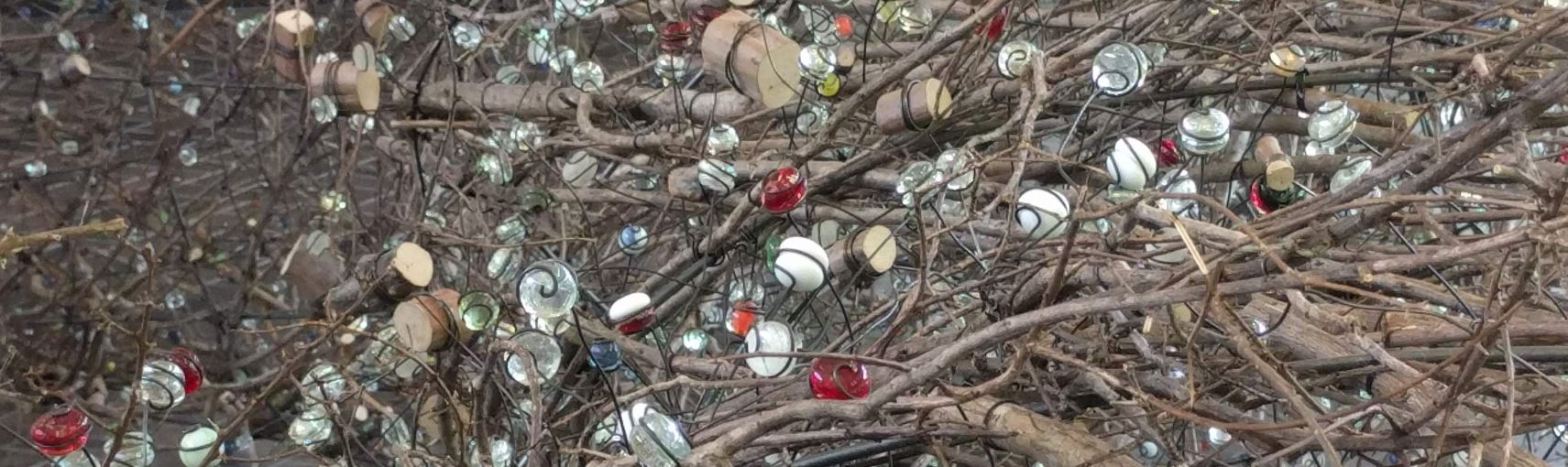
Because you must wear it so closely, you may have a hard time seeing it. Here is what it looks like.
It has a circular form of chain links. The links range from perfect rounds to progressively distorted shapes, because our days are progressively distorted from our expectations until our expectations are re-shaped.
It is made of surfaces polished to a high reflection. It reflects its surroundings, taking them in and taking them on. It holds the outside world, just for a moment, before letting it go.
I already said it makes its own weight. Most times it’s so light you wouldn’t notice, but sometimes it’s far too heavy – the weight of something with inertia, inevitability. Once it creates a pattern it will hold the weight of whatever your Everyday holds.
What does it summon? Your Everyday, otherwise known as “normal.” The details will vary for each of us, but it is always something predictable. “Normal” guarantees today will be like yesterday and tomorrow like today, an unbroken chain of certainty. It also predicts us. We are what we do repeatedly, composed of our own repetitive motions. The Everyday seems to be everywhere, until it isn’t.
Once an Everyday is gone, it’s gone. A new one must be re-made from scratch, from the ground up and the raw materials of life and thought and passions. There’s no point in trying to make it sturdy; it will never be as strong as the world rushing around it. It’s a fragile form, for all it pretends to the weight of the inevitable. I tell you this because you are probably crafting a new Everyday right now, though you may not realize it.
Of course, this Amulet is just a construct, an idea. I did warn you it was an ad hoc arrangement. It can’t give you back what has already vanished. But it can let you see which parts of your changing life are changing you. It can give you a few seconds’ space to choose what you reflect, what you allow to gain weight of inertia – what you allow to be your new Everyday.
When Words & World Well Up
When words and world well up, dark as silt –
A river delta, catchment for time’s hard flow.
The spreading out and gathering in,
Gathering in shape and memory of land;
World remade with each upstream flood.
We are changed because we stand on the shore.
We see change, rather than flow or memory’s flood:
This is the onlooker’s price.
This is the price for not jumping in
When a river roars by your doorstep.
 Skeleton At The Feast