Advent, Day 15: See Through Branches

(Day 15 of this year’s Advent series. Yesterday’s piece was about negative space; today we consider eye games.)

See Through Branches

See through branches, or the pounding rain;
See through a dragonfly’s wings.
See through silence, 
See through pain,
Or walk
By way of night:
One long path of
Things revealed
To those who 
Give up sight.


Have you ever played the child’s game of sitting in a moving car on a sunny day, eyes closed – and turning your face towards the sun? 

The passing trees splash cool against your skin, and their shade smacks your closed eyelids –

But the return to light is swift. It brings warmth and an unreal color: Orangeblackred – said fast and all together now – mysterious in its illogic.

That is: by this age, you have likely already learned the folly of mixing in black. 

You know yellow and red make orange, and orange to red makes…redder orange? And you have also likely found that there are many (many) ways of stumbling into “inadvertent brown”.

But – the matter of black. It’s the surest lesson any paintbox or marker set ever taught. (Don’t talk to me about crayons.) 

Black is always the last color made. When black is added to anything, there is then nothing left to add. 

The fact that one can use the words “orange” and “red” to talk about this particular color indicates that it must be not-black, because otherwise how would those words occur as a necessary part of the description? 

And yet the “orange-ness” and “red-ness” of this color disappear the more one focuses on them. 

So in the end, one says “Orangeblackred,” and by then the car ride is over and it’s time to come to grips with the fact that eyes really aren’t meant to be strained while closed…

Of course, now I know a better term for that color was “my eyelids’ blood vessels.” Which is probably also the next Pantone color of the year. 

But it was an early intro into the way both language and sight reach their limits; and the joy – as in a game – of trying to find words for all one isn’t seeing, even after the point where words aren’t enough. 


Advent, Day 14: Empty Things

(Day 14 of this year’s Advent series. Yesterday’s piece was about the M.C. Escher structure of the second; today we consider negative space.) 

Empty Things

Blessed are those
Who fill their time with deserts – 

With empty things, stables and tombs
A mountain with crowds moved on – 

The leftovers
After fishes and bread
Are gathered in. 


Negative space” is defined as “the empty space around and between the subject(s) of an image.” Its perception is the result of an eyes-plus-brain quirk that can result in optical illusions such as our previously-discussed bistable image, Rubin’s Vase.

Now: if we’re speaking philosophically here – which of course we are – there are two additional little quirky tendencies that negative space tends to bring out in humans. 

Exhibit A is the tendency to focus on the subject and not see the surrounding space at all. This is the “stick a star on it” tendency of holiday preparations. 

And then there’s Exhibit B. Exhibit B is…rough. For me, personally. 

It’s the tendency to yes, see the negative space – and then – to make it something.

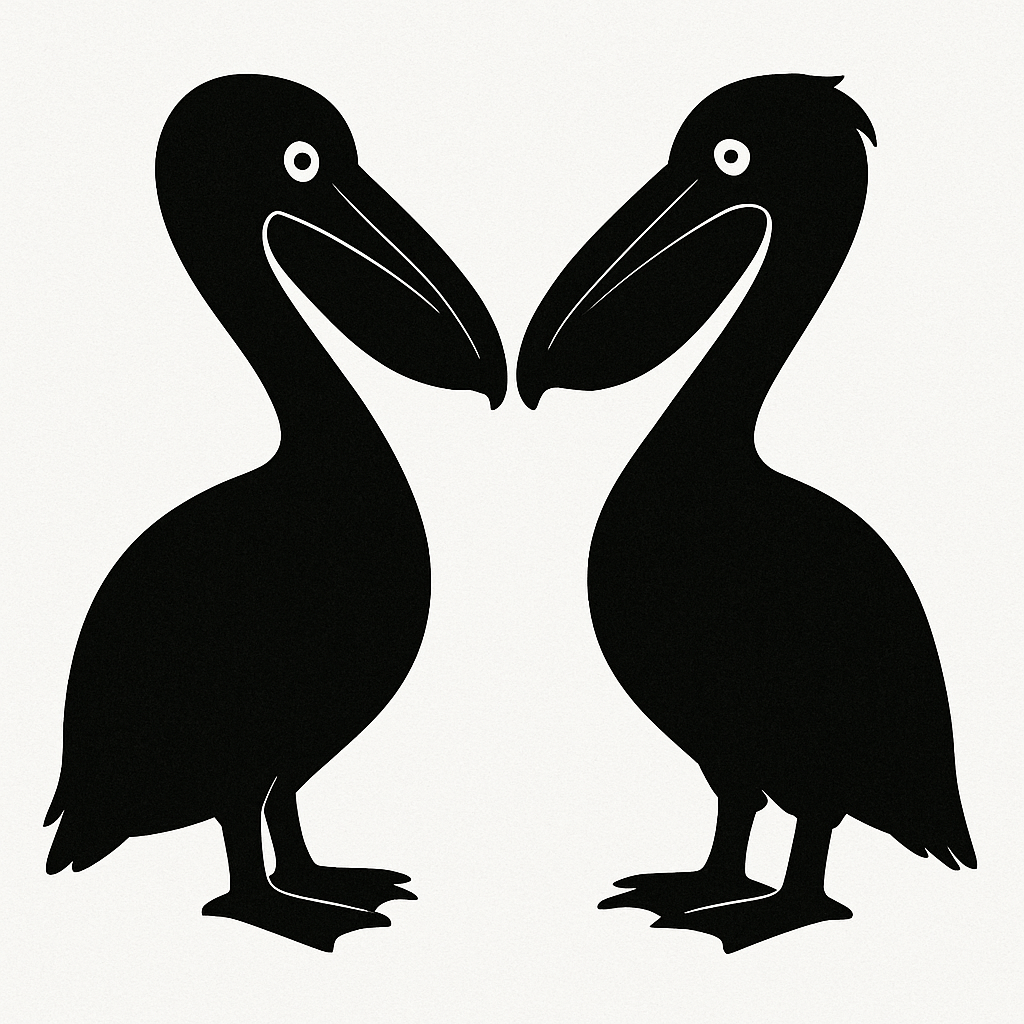
You know. Like a face, or a vase. Or two vases. Or maybe, I don’t know, a pelican. You never know where the average graphic designer is going to secretly stick a pelican into a visual? 

Ok, so maybe that’s the “stick a pelican in it” tendency of looking at things. Negative space is supposed to be *checks Wikipedia again* “the empty space around and between the subject(s) of an image.” 

So: the space is the space is the space. 

Ok, Wikipedia. Ok. I’ll stop trying to stick a freakin’ pelican in every blessed, empty thing. 

Now please tell me there are some leftovers in this empty space other than fish and bread.


Advent, Day 13: Each Second A Temple

(Day 13 of this year’s Advent series. Yesterday’s piece was about transmutation; today we consider the M.C. Escher structure of the second.) 

Each Second A Temple 

(I)
Dearly beloved,
If ever you wonder
At our Lord’s ways, 
Remember you this:
Each second
Is a temple – big enough
To hold all Creation.

 (II)
Each second a temple – 
No walls, windows, or doors – 
Yet the only space I have
In which to meet my Lord. 


My friends – in the spirit of these pieces, let me set aside words today. If you have come to this table, be welcome – let’s just sit together and enjoy all, all that these seconds hold. 


Advent, Day 12: Strange Transmutation

(Day 12 of this year’s Advent series. Yesterday’s piece was about bodies; today we consider transmutation.) 

Strange Transmutation

Liquid, silver, salt: strange
Transmutation,
Yet no stranger than
Bread into body,
Wine into blood
Or water
Into earth.

Bless thou this earthly wine
Back into water –

That I may flow
Over stone
And under soil –
Following your call. 


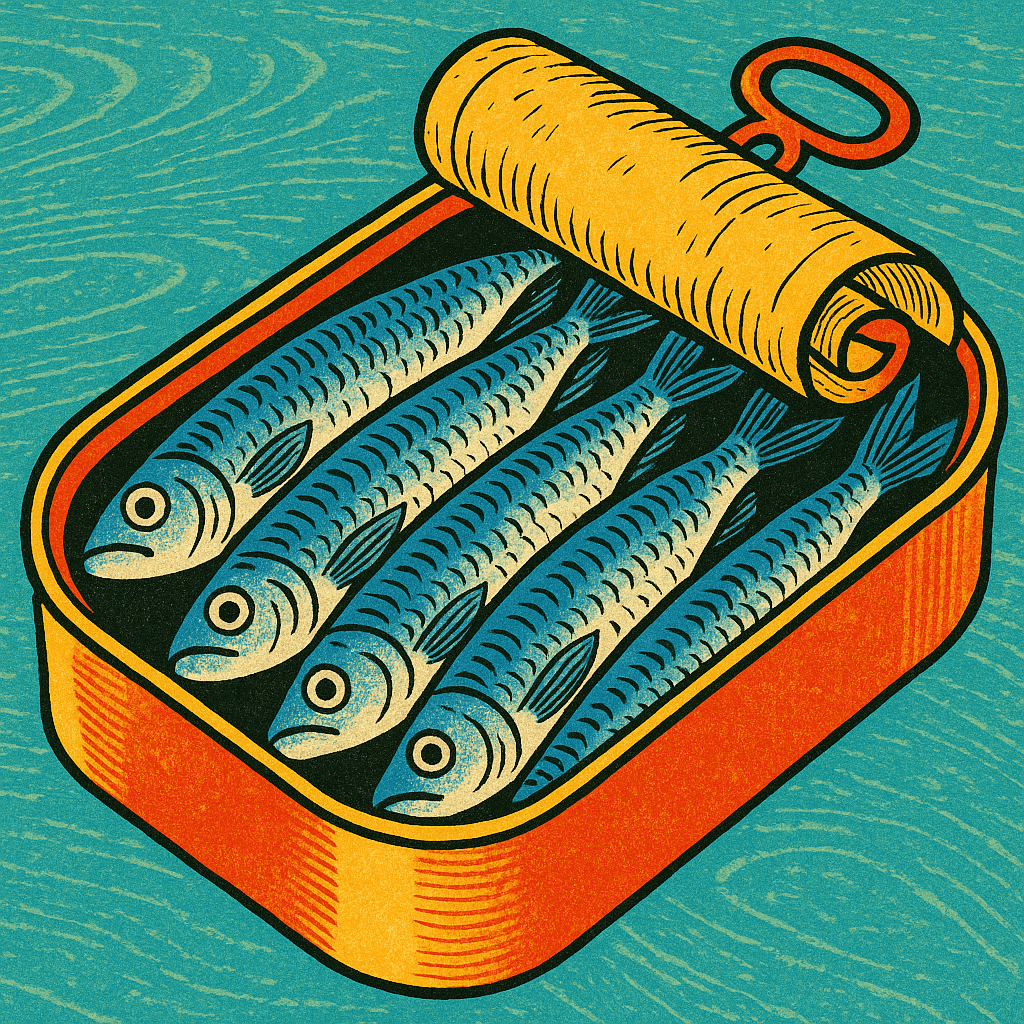
I lead what you might call a “sardine-rich lifestyle.” With precisely 0.00% intent to stock up on mercury, deplete the oceans, or recycle enough cans to form a fleet of Ferraris (“yeah, metallurgy…never knew the name”) – I nonetheless eat sardines for 7 out of 21 meals a week. That’s – hmm, that’s ⅓ of my meals. Huh. 

These numbers are not being idly dropped for bragging rights, you understand. My goal here is to convince you that when I say I know how much energy a tin of sardines holds, I know exactly how much energy that tin of sardines holds. 

Specifically, 4.5 hours worth. If we’re going to talk about transmutations, that’s a pretty decent conversion: 1 tin of sardines for 4.5 hours of anything I want to do. There are very few other simple trades, I feel, that would give me such a happy exchange of the hyper-specific for the utility of the extremely general, while also being fishily delicious. 

Of course, there are probably some…downstream consequences. The great fine-print issue of food chains is that one participates by participating. So eventually I’ll have to make good on all those sardines I borrowed (7 tins a week * 52.14 weeks/year * average life span of oh, 120 years). Still a better deal than most banks offer, but I definitely think about it every time I open another tin and see the little silvery bodies inside. They’re pretty much perfect, except for no heads. 

Now, in terms of systems of consumption, David Foster Wallace wrote a piece called “Consider The Lobster.” I’m not going to quote it here, but I will recommend it heartily as a piece of food writing that is deeply concerned with the problem of exchange and costs, and a far better examination than I can offer.

What I am going to quote is Sir Terry Pratchett, in the Discworld novel Small Gods. The book is, you know, about gods. And belief. And sort of, also, about consumption, as in the actual costs of existing, which from a certain view point – that’s what everything is about. Oh, also miracles. 

….And wine made of water! A mere quantum mechanistic tunnel effect, that’d happen anyway if you were prepared to wait zillions of years. As if the turning of sunlight into wine, by means of vines and grapes and time and enzymes, wasn’t a thousand times more impressive and happened all the time…”

 From the viewpoint of zillions of years, everything turns into everything else. 

From the viewpoint of today, one tin of sardines has turned into 4.5 hours of my lifetime, filled with work, writing, planning a birthday party, and a truly magnificent walk that included a December-blooming rosebush scented like pink lemons. 

From the viewpoint of something-less-than-a-zillion-years, the differences between me, my sardines, and water – or even wine or bread – are very small indeed. All are tiny, temporary bundles in a system of raucous interchange. Don’t poke their edges; atomically speaking, they mostly don’t exist. 

Also, don’t poke my sardines. I need 4.5 more hours out of them.


Citations

Pratchett, Terry. Small Gods. London: Victor Gollancz, 1992.

Wallace, David Foster. “Consider the Lobster.” In Consider the Lobster and Other Essays, 235-282. New York: Little, Brown, 2005.


Advent, Day 11: Let Me See You In Darkness (II)

(Day 11 of this year’s Advent series. Yesterday’s piece was about “life events”; today we consider bodies.)

Let Me See You In Darkness (II)

Let me see you in darkness,
As by no other light. 

With immensity
Or the point-contained hum
Of smallest wonder – 

With direction
Not betrayed by any map
Or star;

In stillness, roaring,
Wave, hum, muteness,
Shush, and susurration –

As if by teeth, or by root
Of wood or stone, 
Hollow bone, 
Xylem, phloem,
Fin or fruiting body.

What, when suntime things are gone?

What purpose free
Of need or use
Except to be –

No need to answer,
That which 
I could not contain;
Except that,
When seen by darkness,
We may be 
Of nature Same.


Have you ever seen a cow scratch its ear? 

I am, naturally, asking with a purpose; the first time I saw this take place, I was utterly shocked. Awe-struck. The fact that a cow (technically a heifer, in this case) could have itchy ears, and also do something about it beyond rubbing against a fence post (my prior understanding of large quadrupeds was that they solved most things by rubbing against fence posts) – the establishment of this fact, via it happening right in front of me, reworked my brain regarding bodies.

This particular cow chose to scratch its ear using its back hoof, just like a dog would. The motion took place with nonchalance, even a kind of competent grace; this cow had definitely scratched its ear with its hoof before, and would do so again. 

It was a gesture that I had never conceived a cow body could perform. My impression of cows was always very…refrigerator-like: rectangular, heavy, don’t swing on them, milk inside. The word “non-flexible” didn’t describe them, because the word “flexible” wasn’t on the list of cow qualities to deny. 

Now, there is of course a reason for this…rabbit hole. (For all I know, some rabbit holes are actually dug by cows at this point. But “cow hole” really doesn’t sound right, so let’s just agree to treat that question with the ignorance it deserves.) It has to do with the question of bodies, embodiment: probably the one and only thing I am prepared to consider miraculous in this world, insofar as anything else you might name is just icing on a thousand-layer (genome-flavored) cake. 

That is to say: it is a true statement that I am attached to my body. It’s definitely odd, mysterious; I’m pretty sure I accidentally ate the operating manual while still in utero.

But I’ve gotten used to doing things a certain way while inside of it. I don’t give much thought to, say, scratching my ears. The fact that I typically use my hands for this is the reason I was astonished to witness a cow treating the matter of ear-scritches with precisely the same level of non-attention while going about it in a way so alien to my own approach that it…that it was really alien to my own approach! Thank goodness it wasn’t an octopus, you know? 

Do you know, though? Do I? About bodies beyond this one? 

Do I know if – for example – octopuses even have ears? (Nope! They have statocysts!) Do I know what it is actually like for a fly to taste with the chemoreceptors on its tarsi; do I know what walls feel like to geckos; do I know what the ground looks like to a squirrel in a pecan tree?

Do I know how the tree senses sunlight? 

Do I know the ways of Behemoth, or Leviathan?

No, no, no, no, no. 

I like to try, though. Since seeing that cow, and a few other instances in my life, I’ve found it a good little mental practice to occasionally sit down in whatever posture least tangles my attention, and imagine eight arms, u-shaped pupils, everted retina, and the ability to squeeze through tiny gaps. 

It’s never going to make it as a “mindfulness” practice. I have to keep a phone handy; few things highlight my lack of comparative anatomical knowledge like the sudden need for, say, a spleen equivalency. (At this point, I’m pretty sure the spleen is just a joke played on humans by literally all other life on Earth, who are still wondering when we’ll work out that we don’t need one.) 

But as a “care-giving” practice – as in, learning how to give care to the beings and spaces and systems all around me that I can’t understand – it’s top-notch. Most empathy and morality comes down to whether or not you can imagine something happening to you: imagine unto yourself, that you do not unto others. 

And if that doesn’t completely re-shape your headspace – 

There’s the ever-present question of how to address an itchy statocyst when all you have are muscular hydrostats to scratch with. 


Advent, Day 10: This, Too, An Advent

Day 10 of this year’s Advent series. Yesterday’s piece was about seeing; today we consider “life events.” 

This, Too, An Advent

This, too, an Advent:
The clotted blood, tired heart or
Time-turned soul.

Light this candle: change to bear,
As change comes yet again and –
Again: it is a steady flame.

This, too, your Advent:
Where hearts break toward a different song

Or sing again – but

Not yet.

Both quick and dead,
Light this flame.

It burns true, both sides the door that love cuts

Through the world. 


The remarkable thing about “question mark spaces” in the year is that they will arrive, whether or not you are ready for them. All you are required to do is remain breathing. 

And of course, this is also true for… life events. 

I say “life events” (that pseudo-euphemistic Millennial-coded marketing term) but what I really mean is…you know, the sort of thing that could actually, also be called: life-but-we-really-hope-not-ours events. 

Those little sections of awareness that both rivet and fractalize your attentions into:

The sensation of living chunks of several divergent lives at the same time or 
The sensation of living chunks of someone else’s life at a very specific narrowing time or
The sensation of please-don’t-let-this-be-my-life or
Please don’t let this be someone’s life any more – or 

Really, just “please.” 

Sometimes there’s nothing to even ask for, at least as far as “use your words” is concerned. 

In the interest of not using my words, then, allow me the cover of a quote, from Barbara Brown Taylor’s An Altar in the World: 

“I have to be careful here, or I will sound like one of Job’s pious friends. No one who is not in pain is allowed to give advice to someone who is. The only reliable wisdom about pain comes from the mouths of those who suffer it, which is why it is so important to listen to them. That way, when our turn comes, the rest of us will not be clueless. We will recognize at least some of the territory and remember what those who went before us told us about what comes next.” 

I try very hard to remember these words whenever I can. There is only one thing I quietly add to them, within my own head: although “what comes next” is certainly a great part of all this, it’s the “what comes now” that really can’t be skipped.


Citations

Taylor, Barbara Brown. An Altar in the World: A Geography of Faith. HarperOne, 2009.


Advent, Day 9: Let Me See You In Darkness

(Day 9 of this year’s Advent series. Yesterday’s piece was about uncertainty (again); today we consider seeing.)

Let Me See You In Darkness (I)

Let me see you in darkness,
As by no other light.

Let me see from the facets’ inside plane;
Let me touch your pulse,
Your blood line’s other vein,
The sundown flow from
Heat or heart unknown.

Let me know you by that which you hold
Unseen,
As by no sight can every truth be shown –

Let me know, as things unsaid,
That which daytime answers fail to frame.

Let me see you in darkness –
Where words and worlds end; 

And, caught by your far Other side,
My day-bound eyes –

Transcend.


A river runs through Austin. Part of my day is crossing it twice: once in the early morning, once in the evening. 

As with most rivers, it is often wrapped in mist or sunrise and egrets. And it is a beautiful thing to see like that.

But it is a different creature when the clock does not match up to the sun; when the human habit of hours turns my transit nocturnal. Then, it is something not-seen – and bigger for it. 

The river breathes in darkness. The sense of it swells towards immensity; it becomes more than the place dividing two shores. It is every sense other than sight. One feels the weight of the water, the flow of a piece of the continent; one feels on the edge of – 

Something that requires setting aside sight, and perhaps speech, to comprehend.


Advent, Day 8: The Unequivocal “Maybe”

(Day 8 of this year’s Advent series. Yesterday’s piece was about negative space; today we (again) consider uncertainty.)

Here is a fact: I place my firm belief in the unequivocal “maybe.” “Uncertainty” is (quite possibly) one of the strongest recurring themes ‘round these parts. 

This observation arose from the following: today’s Advent piece – according to the original sequence c. 2022 – was already posted here in 2024, under the title Lady of Liquid & Silver & Salt


Lady of liquid and silver and salt, 
Lady of mist and flame –
Strike in my heart your burning bush, 
Devour my soul again. 

Lady of risings and leavings and flux,
Lady who moves most unseen –
Unmake my certainties into dust, 
Awaken my dust with your wings. 

Lady who changes all things as She will,
Lady whose peace is to bend, 
Unmoor my sight from promises firm,
Your holy uncertainty tend. 


Bet you didn’t see that conclusion coming. 

In fact, in Advent Day 1 we also touched on uncertainty, although in that case, more as an antidote to the foregone conclusions of reality’s wake. 

And the three posts prior to Advent dealt with: embodied uncertainty; fluidity as a crucial thread binding meanings to myth; and, last but not least, the porosity of the emotions that shape relationships: 

It seems nothing is definite, certainly not something as crucial as the twinned shapes of love and grief. Their focus is not static, and neither should they be. They are held, given, mined, stolen, shared.

A reasonable question, then, would be: “Why uncertainty?” What do I hope to find, eventually, from an apparently bottomless well of (???)…? 

You know, I too would like to know. 

Fortunately, past-me (c. 2020) left a few clues lying around. 

In the spirit of pinboards and string, then, here is a crucial piece of answering that question. 


I Dislike Telling Stories

I dislike telling stories. People always say, start at the beginning, and I get lost looking for it.

Stories don’t really have beginnings; they’re more like cats. They like to wander in and out as they please, and you’re left picking up small furry corpses and thankful they didn’t bring in a live raccoon this time.

As for endings – most people have a pretty good sense of where stories should end. The problem is, they end – and then they continue. It’s like the drive-through scene in Dude, Where’s My Car: “And then? And theeeeen? AND THEN?”. 

I think of stories more like moments of small revelation, piling up. When enough of them accumulate, the mystery or displacement or unease driving your interest in the whole thing collapses like a house of cards into a (hopefully) satisfying sense of resolution…until the accumulation begins again. Call it the Snowdrift Theory of stories.

The trick with revelations and resolutions is they are incredibly subjective. Monsieur Poirot closing a case is, realistically speaking, the middle of five or six other narratives that have likely been going on since about the middle of Dame Agatha’s novel. One can imagine characters coming home for dinner, chatting over mid-century modern and martinis  – “Oh darling, you’ll never guess what I heard today. It was the stepson all along!” – and then getting back to the all-consuming business of their own storyline. 

So: every story is just a point of view. Call it the Point of View Theory of stories. 

It’s also hard to pinpoint stories because, once you know people for a while, you just hear snippets of their life, fading in and out like a radio station. 

For example. For most of my life, I thought I knew a story in full. A boy grew to the age of 14, ran away, Did Drugs, Became An Alcoholic, Was Saved, married, and lived happily ever after as a carpenter in the mountains of New Hampshire. It was a pretty good story.

After he lived happily ever after, his wife started hearing voices telling her to divorce him. They were separated for a while and then she came back. They lived happily ever after, again. They restored an antique barn. 

After they lived happily ever after, again, he learned he had Hepatitis C. 

His wife said she didn’t have time to take him for blood transfusions. 

He got sicker and sicker. 

His wife, a very loud person, talked about praise and martyrs. 

Sometime in the winter, he died. His family didn’t find out until after he’d been cremated. It felt like he just got lost somewhere in the winter and never came out to springtime. 

The last part isn’t completely true, because it isn’t true to him; that’s not how he would tell it nor want it told. But it’s true to the pain of loss, like dark water under ice, in the silence of wintertime woods. And even that isn’t an ending, because it doesn’t explain how the dark water and the silence now runs through other lives, changing them in small everyday ways. 

Words are different from stories, because words don’t try to give an ending. The purpose of some words is just to help you find a way through. When you’re walking through dark woods, you don’t look to the right or to the left; you look at the path, because if you look away you might lose it. It’s also a bad idea to think too much about where the path goes, either in hope or fear.

From the Point of View Theory, I work with words, rather than stories. I work with words, at the end of stories, outside and around the stories I see, a framework of understanding and a misguided attempt at benediction. I try, over and over, to make some sort of path through the confusion and mess and fear. Faith, hope, and love may abide, but in order to “abide” I have to understand where I am – in the thick of it. 

From the Snowdrift Theory, the cards come together to say something like: I may not see a beginning, and I certainly won’t see an end. Lives and events happen around me, some of which I may be aware of and some of which are beyond my understanding. I try to make a neat framework of understanding, but the system is greater than the system. 

Pay attention to what is in front of you. You may not see it again. Seek to craft a way through that is better than what is on either side, for anyone who may follow behind you. 

Like most stories, this has no true end. But I’ll leave it here. I may wander into it again, like a cat wandering into a kitchen. Or sometime in the future I may again happen on my own tracks, leading into stories for which I can find no beginning or end.


(Originally posted here January 2020).


Advent, Day 7: I’ll Leave You Space

(Day 7 of this year’s Advent series. Yesterday’s piece was about moments that hold themselves; today we consider negative space.)

I’ll Leave You Space

Dear heart, I’ll leave you space:
I’ll quiet the seas
And close the mouths of lions’ roar –
I’ll welcome thieves,
If they take all and leave more
Room for you. 

This only gift I have 
To share: what I have not,
What I fill not, 
What is open in the center

What I leave as space untouched
By best intent.


There is, of course, a notorious phrase surrounding good intentions. Yet even setting that aside – I have never been so tangled up in life as those times I tangled myself, usually through…well, maybe not just good intentions, but a certain dash of “desire to perform the right thing” – gently muddled into the cocktail of “unrealistic expectations” and served at room temperature –

Let’s leave that glass to trap fruit flies on the counter. Put it down, set it aside, pull out an empty glass in its place; place that glass on the counter, too, then leave the kitchen.

Sometimes an empty glass holds everything it needs to.


Advent, Day 6: Stillness Under Sound

(Day 6 of this year’s Advent series. Yesterday’s piece was about the squirrel-space continuum; today we consider the contradictions of stillness.)

Stillness Under Sound

This morning, so much stillness
Under sound – 

The stillness of all thousand souls alive
Before the fall.

What fall? This morning – flight:
All trembling leaves

Share this soul’s
Delight.


Imagine leaves, tossed reddish-gold-green against a blue so high your eyes want to shout. The air around is moving, has been moving all morning – brisk and constant and timed to its own knowledge of space; the leaves never stop moving in this air. They are on a branch, but that branch is moving too. And after watching upwards for a while, you also are conscious of moving. Leaves, air, branch, you: you’re all flinging yourselves upwards towards the sky, all bathed in high blue, wave-caught in an instant – later thought of as – the “updraft joy.”

Such moments hold themselves.