Postcard from Solitude’s Beach

What do you hear in your silence?

I confess, the practice of solitude is not hard for me. By preference I am a creature of silences, long thoughts, and deep abstractions, always just out of step with time. 

Some of you are able to jump into life. You swim in it, splashing around. Some of you are able to experience things to the fullest, fully present in each moment. Some of you laugh in the surf and dive past the shallows into deep breakers. 

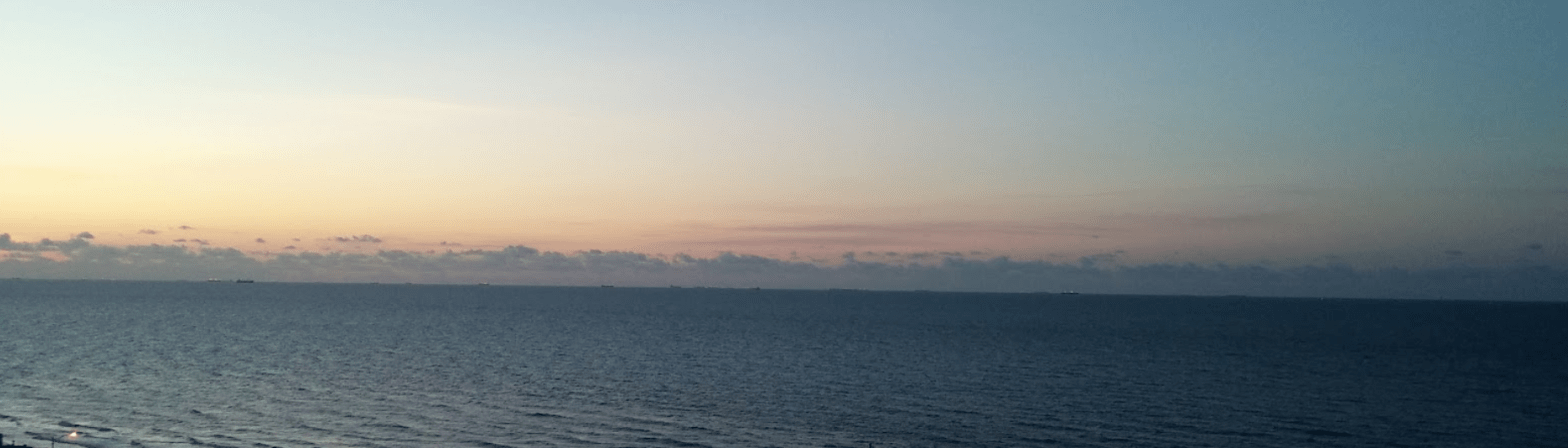
I stay on the shore. I watch many of you, seeing waves and ripples. It’s a constant mystery how you deal with the ocean, salt in your eyes and sea breeze tugging. It’s much calmer on the shore where it’s quiet. It’s much easier to think over here.

It’s easy to feel my shore is unchanged by the larger waves crashing along the beach right now. History indicates this will not be the case. 

At some point, the Jaws theme will play, even for me. Too dramatic? Very likely, and cliched too. How’s this – at some point, the Titanic soundtrack will echo, even on my beach. Solitude is comfortable for me; it may be hell for you. But the real struggle begins when solitude is no longer an option – of refuge or of last resort – for either of us. When everyone is out of the water, but the beach itself is also closed. 

A tsunami is a giant wave. As you may recall from highschool physics, a wave has two parts – a peak and the lowest part, a trough. If a tsunami’s trough hits a beach first, it appears as though all the water has receded into the horizon. 

It’s an inevitable calm, and it inevitably cannot last. When the trough hits, the peak will follow – and the peak’s strength corresponds to the depth of the trough, equal-opposite. 

We are in the trough right now. Not everyone, to be sure: some of you have already experienced a glimpse of the peak. But in general, if you live in the U.S., we are in the trough before the projected state-by-state peaks of covid-19 cases. The peaks will start to hit in mid-April. 

We’ll need each other from a distance. I’ll need the knowledge of how to stand in the midst of breakers, whether I want to be there or not. You may need to know where the shady beach-spots are, how to sit quietly and pay attention. Each of us will be simultaneously out of our element. None of us will have the luxury of that most ingrained of human responses, seeking strength in numbers during times of trouble. 

It will feel as though John Donne taunts us: everyone will feel as though they are, indeed, an island. 

Perhaps we’ll hear echoes of each other more clearly in our individual silences?

Wherever you are on your beach, waves or whirlpool or sand, listen for me. I echo through books and verse, scraps of paper you find in the tides. I’ll look for your mark in the traces of salt and tide, the distant laughter on the sea breeze.  

None of these things are what we’re used to. They place each of us out of our element, barred from human contact and banned from comfortable isolation.  They bring each of us closer to one of two places – insanity, or understanding. Solitude leaves you alone with yourself and forces you to examine whatever echoes of other people you find around you. Solitude may push each of us towards fostering our own version of that most essential of human experiences, empathy.

And in the meantime, at least John Donne isn’t contagious.


‘No Man is an Island’, John Donne

No man is an island entire of itself; every man 
is a piece of the continent, a part of the main; 
if a clod be washed away by the sea, Europe 
is the less, as well as if a promontory were, as 
well as any manner of thy friends or of thine 
own were; any man’s death diminishes me, 
because I am involved in mankind. 
And therefore never send to know for whom 
the bell tolls; it tolls for thee.

MEDITATION XVII, Devotions upon Emergent Occasions


Apocalypse Is A Question
Contrary to common opinion, the world doesn’t end with a whimper. It doesn’t even end with a bang, despite the fondest fantasies of both the fireworks manufacturers and adult film industry (in a truly spectacular example of converging alternate realities). 

Instead, it’s the letdown without the cliffhanger, the punchline before the joke that never comes. The world ends with a question. 

The jury is still out on what the question may be. The fact that this is a continuing debate is proof that we haven’t yet found the winner. But we have seen some strong emerging contenders. Each year I believe it more likely we may identify a winner within (or rather, concluding) my lifetime1

The ever-popular: “What does this button do?” is a bit of a Cold War-era cliche. Its grown-up counterparts: “How can we disrupt the market?” and “Is there an app for that?” 

“What the Hell?” is always a popular contender, with the advantage of being both concise and not specific to any particular era or socioeconomic bracket. 

Other classics2 include:

When will we return to normal?
Why didn’t you say something? 
Why didn’t we know? 
Why didn’t we listen?
Did it have to be this way?
What have we done?

I’ve been told these are too many questions, and readers want a Call to Action. Rather than question such advice, I humbly deliver the following.

Today, ask yourself: Can it end differently? What can I do to make sure it does?


1 You think I’m kidding? Believe me, I don’t want it to be this way. It’s no fun to talk about. Writers need dramatic conclusions in order to thrive. Barring those, we at least need a (read: any) conclusion. A question isn’t a conclusion. A question is frequently viewed as a sign you haven’t researched enough. Every piece of writing advice on this planet exhorts writers to end with a “Call to Action,” whatever that is, whatever the action may be, responsibility be damned. 

2 Other classics, not included, include: “You wanna play a game?” and “Why so serious?”

Don’t Break The Spell

Don’t break the glamour, don’t break the spell
Who cares if they think you write so well?
You know, that’s all; a universe of one
And when all is said (on paper) and done
Words shape minds; your own most of all
So write the human you can’t quite recall.
The one who hides behind desk job and chores
And grocery trip runs and tasks you abhor
But the glamoury works on you as well
So whatever you do – don’t break the spell. 

A Heartfelt Verse

I am deeply grateful for this cup of tea
Without it I’d be asleep, you see
Within its steaming Lemon Lift depths
Lurk blog posts, theses, a codex
Of all the words I have yet to say
Before my readers run away.  

When I Talk About Wonder

Did you ever read David Foster Wallace’s 2004 Gourmet magazine article, “Consider The Lobster”?

It’s about lobster (as you would expect), but really about consumption, alienation, and pain. It’s a Hell of a read. 

I would also say it’s written with wonder. Please don’t choke on your tea. 

I realize I’ve thrown the word “wonder” around in a few posts now, and I’d like to clarify what I mean by it. This does not mean I seek to clarify how you experience wonder. It means I would like to lay out the assumptions I make when I use it as a verbal shortcut. 

In short, when that five-letter word shows up, I’m not thinking about unicorns and sparkles1

Wonder: the capacity to be surprised, to acknowledge the world is not as you thought. The compulsive desire to push beyond the easy answers.  

It requires you to a) pay attention and b) be prepared to work on a moment’s notice. 

When the world is not as you thought, when your mind betrays you, when you’re angry and you don’t know why – those are all experiences of wonder.

Those are all times when, if you’re paying attention, you say: something surprising is going on. Something is different. The world (this world, your world, any scale of world you choose) is changing, and the capacity to throw yourself at that change and seek its currents is the core of the experience of wonder. 

If you’re willing to work with wonder, you won’t lack for things to talk about. The world is full of easy answers to be pushed beyond. 

Now with that small matter out of the way, let’s get down to the real business: do you have an emergency plan for when the unicorns and sparkles show up? 


For another, different perspective on wonder, head over to Syd Weedon’s post on A Small Blue Marble: A Lady Who Means Well and Gives Free Advice on the Internet. 


1 In fact, I REFUSE to talk about them. At least since the Unicorns & Sparkles Incident was successfully hushed up. You didn’t hear about it here.

You Don’t Find Fossils in Granite

You don’t find fossils in granite1
So why do I find them all around?

Sedimentary, my dear Watson2
We are formed not by fire
But only time’s slow drift.

Inertia forms its own mass
Of things drifting down:
Trickle down, 
Things settling, 
Price of settling, 
Price of gravity –

The price of what? 

A great geological cover up.

Don’t blame those who excavate
What once was alive. Those fossils
Are decently dead and done. 

I speak of our economies, policies, 
Philosophies, rivalries:
The bones of an ancient,
Covered by convenience and things let slide,
Until it appears a mountain 
That, they say, is immovable.


1 It’s true, and I never thought about it until coming across this information in David B. Williams’ Stories In Stone: Travels Through Urban Geology (an interesting read for anyone with interests in any combination of architecture, history, urban planning, geology, and offbeat coverage of natural science topics). As you may recall from grade school, the three types of rock are sedimentary, igneous, and metamorphic. Granite is a metamorphic rock, formed by fire and time; the fire does for any organic remains what a flamethrower does for a paper crane. Therefore, you will find no fossils in granite – or any metamorphic rock – or igneous rock (hardened lava) for that matter. Only sedimentary rocks hold fossils.

2 Often imitated, never initiated – according to Quote Investigator (a truly entertaining website), Conan Doyle’s Holmes never used this precise line in any of the books or stories.


Sesame Street Eyes

Sometimes I miss my Sesame Street eyes. 

Like many children in the English-speaking developed world, I grew up with the show. I didn’t necessarily have an archetypal experience of it: I didn’t have dolls or merchandise of the characters, I didn’t watch it on a color TV. I didn’t know Elmo was red until I was six. But I watched it in a house, with two parents downstairs, and the promise of lunch afterwards. And I watched it with a great deal of curiosity and fascination. It was my first window on a wider world.

The exotic locales were part of the allure. New York City brownstones, fire hydrants turned into summertime fountains, taxis and subways – these became a visual vocabulary of Other, something I desperately wanted to see for myself. I started to look for it on every cracked sidewalk of my own Midwestern city. Eventually I started to see that there were other stories out there that went beyond my neighborhood, my small span of years and city blocks. 

For example, the corner store 7-Eleven where my mother bought cereal and spinach was a small revelation. I looked at the pig’s feet and head cheese and tubs of lard, listened to the accents that had ridden in on currents of economic hope during the Great Migration, and began to wonder. This was a culture that Sesame Street hadn’t shown me, but thanks to the show’s influence I recognized the pattern of Something Different – a story waiting to be understood. 

Each Sesame Street episode built on this need to understand. I saw other children who lived curiously different lives. He herds goats? Wow. She walks through rice fields instead of streets? Wow. They take a boat to a school housed in a hut built on stilts? Wow. 

That little girl carries her family’s water supply from a well? Wow. She studies by candle light, eats rice or pounded corn mush for every meal? Well, she has a mommy and a daddy (imagine Elmo’s voice), just like me. She has siblings – not like me, but fun to think about. Not so different after all. 

In all of this, there was no judgement or dismay, just wonder and curiosity. Each of the children’s lives was portrayed as something happy, whole, and complete. Boats, mules, and walking were just as desirable a means of transit as subways, buses, and cars. Spending your day herding goats or carrying water jugs was just as fun a pastime as baking cookies or watching Sesame Street.

Sometimes, when I read the news now, I worry about the kids I saw on Sesame Street. Their goats may have died during drought. Their parents may have died in a civil war; their siblings may have died from holoendemic disease. They may be in a refugee camp. They may be working in a factory, dying from heavy metal fumes so I can have a computer and smartphone. They may have been raped or kidnapped while carrying water. There may be no water for them to carry.

They may have had their own children at age 14 or 16, while I was studying and just beginning to learn life as an adult. 

They may have died in childbirth or unsafe factory conditions before I graduated college. 

What on Earth happened? And – hum along to the show’s intro, all together now – can you tell me how to get, how to get back to Sesame Street?

Here’s the deal. I don’t regret that early exposure to a beautiful utopia in which herding goats was just as much a learning experience as attending school. It was a fantastic place. I wish I could still see it. I wish everyone could see it, free from malaria nets and industrial smog.

I just wish I would have known, early on, that it didn’t yet exist. Big Bird could have told me: this is what you’re working towards, kid. Don’t stop until you make it. 

Follow the cracked sidewalks, read the newspapers, listen to people’s stories. When you find people with everything, give them curiosity about a world beyond their comfort and experience. When you find people who have nothing, search for the resources they need. You will need to work, and you will need to fight. You’ll need tools. 

Cookie Monster could have taught me about sugarcane and neocolonialism and banana republics. Oscar the Grouch would have covered social justice and liberation theology. Gordon and Susan could have talked about the African diaspora and cotton, the same cotton that eventually pushed people into the neighborhoods clustered around 38th Street in Indianapolis; pushed them right past the American Dream all the way to the 7-Eleven where I watched as my mother picked out WIC-eligible spinach and cereal. 

I guess I learned about each of those things, after all. 

There’s no good ending here. I don’t have words of wisdom or a neat conclusion. I have lots of questions, and none of the right tools to address them. I have a voice, but a third of the time I don’t use it and another third of the time no one is listening. The last third of the time, I’m not the right person to do the talking. 

When I was young, I thought the world was like Sesame Street: my Sesame Street eyes. When I’m old, many decades from now, I’d like those eyes back. Not because of delusion or platitudes or wishful thinking, but because the truth in front of me might match up to the reality of a world where my species genuinely prioritizes the right of each life to exist happy, whole, fulfilled, and complete. 

In the meantime – I have a suggestion. A small change in the familiar Sesame Street soundtrack, to start the newest generation off with the right knowledge and tools. As the Sesame Street end credits run, the new theme should be the final verse of A Hard Rain’s A-Gonna Fall, by Mr. Bob Dylan: 


A Hard Rain’s A-Gonna Fall, Bob Dylan


Oh what’ll you do now, my blue eyed son?
What’ll you do now, my darling young one?

I’m goin’ back out ‘fore the rain starts fallin’
Walk to the depths of the deepest black forest
Where people are many and their hands are all empty
Where pellets of poison are flooding the waters
Where the home in the valley meets the damp dirty prison
Where the executioner’s face is always well hidden
Where hunger is ugly, where souls are forgotten
Where black is the color, and none is the number
And I’ll tell it and think it and speak it and breathe it
And reflect it from the mountains so all souls can see it
Then I’ll stand on the ocean until I start sinking
But I’ll know my song well before I start singing

And it’s a hard it’s a hard and it’s a hard
And it’s a hard rain’s a gonna fall
And it’s a hard and it’s a hard and it’s a hard
And it’s a hard rain’s a gonna fall
And it’s a hard and it’s a hard and it’s a so hard
And it’s a hard rain’s a gonna fall


(Elmo’s voice) Today’s post has been sponsored by the letter “A” and the number “0”!

Did You Hear The News?

Did you hear the news? 

What news? Any news. You can pick your source; it doesn’t matter if its via internet, radio, print, or television. They all say the same thing. Today they are united in announcing a great development.

In light of recent events – well, events stretching back years, really – we’re making April 1st the new national holiday. It will replace July 4th, the day formerly known as Independence Day; we value fools over independence anyway, and it’s time to stand by our values. 

This is a dramatic change. No other nation has previously embarked on such a far-reaching realignment of national priorities and policies. We see this shift as a necessary action to stay true to our larger purpose within the global community: that of beacon, guiding light. 

Some minor adjustments to national branding will be necessary. We are discarding the “City On A Hill” ideology in favor of “Ostrich With Its Head In The Sand,” which focus groups have repeatedly indicated speaks to the new American public. As part of this reimaging campaign, several national monuments will be re-designated to fit the needs of a changing American society. 

The Statue of Liberty will be moved to the U.S.-Mexican border, where it will provide vital training towards our immigration agents’ target practice. 

The Lincoln Memorial – which stands for national healing from some sort of division that no one can see or talk about – will be deconstructed and reassembled into a true symbol of unity across differences1 for all Americans: a Walmart. 

The Smithsonian museums are already closed, due to the stock market meltdown. Plans to reopen them have been postponed indefinitely. A spokesperson says, “They were free to the public anyway; no one will miss them.” It is likely that many libraries and universities will also be re-aligned towards new national needs in the wake of a stifled global economy. 

The reason for the closed institutions, stifled global economy, shelter-in-place orders, underfunded and overworked public health agencies, and over 43K deaths, is irrelevant to this new generation of Americans. Today’s Americans aren’t concerned with reasons. Today’s Americans are driven to accomplish tasks, and never you mind who is driving them. 

With this new shared vision, we know we can count on our fellow citizens to rebuild this great nation’s shattered c-suite raise schedule and executive perks, definitely at the cost of their own health and future prospects2

Ultimately, this new national direction is more in line with both public values and private interests. New priority will be given to shooting ourselves in the foot; bonus points apply if you hit both feet and your neighbors with a single shot. They were always different from you anyway. Wait, what’s different – your neighbors? Who cares about them? I’m talking about your feet; don’t trust anything capable of walking either to the Left or the Right. From now on we all walk in only one direction. Look at the Egyptians; they seem to have managed it. You know you’re viewing a successful civilization when we’re still busy excavating their dead after this many years. 

Some of our new national priorities will require adjustments from all our citizens. We ask them to remain close-minded in these times of re-entrenchment. Remember: cough on your enemies, run from your friends. Prop up the market and accept you can’t afford to buy. We’ll be back to normal by Easter; we’ll be back to normal by the end of April. We’ll be back to normal when we all stop asking questions, the sure sign of an active mind. 

I’d say April Fools, but it looks like it started early this year and may extend indefinitely.


1 Except for differences stemming from poverty and lack of income. Those differences don’t count as differences to be overcome because they’re actual differences.

2 World War II would be proud, kids. Maybe we’ll even give you a new generational designation, along the lines of the Greatest Generation? Something catchier, something that can’t be surpassed – wait, I have it. The Last Generation.

A Brief Field Guide to Apocalypse

I’m not talking about the apocalypse – the Apocalypse beloved of prophecy and heavy metal. These days, it’s merely an apocalypse. It’s a bit more serious than a teenager saying “my world is ended” and a bit less graphic than meteor showers and dinosaurs. 

In fact, the way we talk about apocalypse paints it as a rather everyday, if dramatic, occurrence. The smorgasbord of options is both creative and overwhelming. There are the DIY projects, the “Bring In The Professionals” advertisements. There are endings both mass-market and stiflingly up-market, personalized and one-size-fits-all.

For example: entire genres of filmmaking end the world as a matter of course. Ever since Hollywood saw the iconic “Earthrise” picture from NASA, they’ve been figuring out how to blow it up multiple times a day. Considering the difficulty of getting a good shot, not to mention the business of sequels – they presumably have several backup copies of the real thing.

(“God, Bob, why are you such a klutz? That was our second-to-last copy of Alderaan! Now GET IT RIGHT!”)…([later, in post-production:] “ALRIGHT WHO WAS EATING CHEETOS! THIS LOOKS LIKE AGENT ORANGE, NOT THE DEATH STAR!”)

Then there’s the matter of faith. Despite what I said earlier, there really is quite a difference of opinion among various religions on the matter of the End of Days. I’ve always wondered why people didn’t select faiths based on the longest estimated TTA, Time To Apocalypse. Perversely, a more immediate TTA seems to attract more believers. I’ve never been sure whether this behavior is driven by a) boredom, b) the desire to see Bob, Karen, and the rest of Accounting/Those People fry, or c) a sort of practical, “Git ‘Er Done” mentality.

The options are endless – well, not really. If you’re dealing with the end of time I guess they aren’t. Rather, there seem to be three main camps of opinion.

Option 1: Less is More. The “poetry lovers’ special”, popularized by T.S. Elliott in The Hollow Men: “Not with a bang but with a whimper,” etc. etc. If you have used the word “ennui” more than once in your life, not as part of a spelling contest, this is your tribe.

Option 2: More is Less. This is the option for people who like to debate, and prefer questions over certainty. There are many theories of apocalypse flying around academia, not all of them tied to publishing deadlines and departmental funding. Some of the most memorable include – I kid you not – the Big Rip, the Big Freeze, the Big Crunch, and the Big Slurp.

Option 3: More is More. This is like ordering The Works at a diner: horsemen (horsepeople?), angels, books, frost giants, rains of fire (reigns of fire?), as many free coffee refills as your heart can handle. Hey, kid, enjoy it while it lasts. We’re turning the sign to “Closed” after you roll out. 

Are there other options out there? Undoubtedly. Let me know what I missed in the comments. But don’t get too upset if I omitted your favorite – after all, it’s not like it’s the end of the world or anything. 


For more fun with finality, I recommend Thief of Time, by Terry Pratchett; and Good Omens, by Terry Pratchett and Neil Gaiman. If you’re feeling a bit more serious and natural science-ish, try Apocalyptic Planet: Field Guide to the Future of the Earth, by Craig Childs. 


A Short Walk Towards Normal

It seems “normalcy” is in high demand. I’ve heard a lot of people lamenting or demanding it the last several days. If they could talk to normalcy’s manager, it would be in trouble; if I could manufacture it in a shed and sell it out the back door, I’d be rich. Sadly, such is not my skill set. 

Instead, from what I have I give to you: today I took a walk. 

You may or may not have the ability to walk outside right now, but please join me.  You’re welcome to share my eyes and thoughts, skin and nerves and bone. Normal or not, today is a day to share with others.


I’ve clambered down into a drainage ditch that captures stormwater runoff from my apartment complex. A few days ago it held water from recent rains. Then, it looked mysteriously swampy. It looked like the sort of place you might see alligators, maybe even plesiosaurs, as wading birds stalked through the pools. It looked like the sort of place with lost temples and malaria and Indiana Jones’ Lost Sequels.

Today the water and plesiosaurs are gone. In its place are grasses and clovers, oxalis and plantain and dandelions: the sort of determined springtime growth best described by the richness of the word “vegetation.” I balance on the concrete rim of the stormwater outfall structure, avoiding the teeming life as I watch. There’s a constant fluttering motion over everything from small moths and butterflies, white and dusty blue and yellow and speckled black and grey. They are busy with the business of pollination.  They are busy ignoring me, not that it takes any effort. For this moment, this is their meadow. 

The butterflies aren’t alone. The birds are also here, everywhere. They’re mostly mourning doves, blue jays, and mockingbirds, a Central Texas trio, their voices the only sound that out-competes the grasshoppers. Sweet softness from the doves, and a puckishly trilled repertoire delivered with the mockingbird’s usual panache; the less said about the jays, the better. 

Even on a day like today, with so many distractions, I pay a lot of attention to where I’m going. You just can’t trust Texas grass. It harbors all sorts of surprises. Self preservation has taught a habit of watching the ground to avoid fire ant mounds. But today I have to look up more often. Inchworms the color of a kiwi’s insides drift through the air on silk strands. A few times I have to dive quickly. The tiny critters drift deceptively slow until they’re right upon you. The trick is to avoid diving into a fire ant nest when you’re busy avoiding airborne inchworms.

In the shade it’s a lovely temperature for cold drinks and deep thoughts – not the kind you need to tell anyone, just the sort you keep for yourself. I think if you’re lucky, the bedrock of your personality is laid down on an afternoon like this: sunlight, breeze, the whirring of grasshoppers, slow liquid layers of thought that settle around your hippocampus, sealing in time. As the seconds evaporate, the warmth remains. It settles in through your eyes, your skin, and fills you out like a second skeleton.  

This is the sort of day where boredom has no meaning, because each second matters.


From an apartment balcony comes the sound of someone sneezing. I make a wide circle around the building. 


The non-human world is utterly oblivious to the panic, the anxiety, the talk of the economy and political games of chicken. The non-human world has exactly one thought: it’s spring. What with ice ages and meteors and volcanoes, you can’t take spring for granted. You never know when you’ll see another one. 

It’s worth it to see this one. 

Now I admit, I don’t lack fear. I’m afraid of wasps, terrified of hornets, and obsessively horrified by scorpions. I have bad luck with fire ants and remarkable luck tripping into armadillo holes. It’s a shame I live in Texas. But it’s a constant source of wonder I live anywhere, at any time. It’s worth paying attention to the moments around me, because no one else has seen them through my eyes and I may never see them again. 

I try to pay attention to living, because it’s a limited commodity. My life, yours – one day they’re going to irretrievably change, or end, or evolve beyond anything other humans will recognize. 

First Draft

Are you looking for “normal”? This is what it looks like: constant change. Continents, species, cells, sunrises: none of them are ever stable. None ever reach a point where they finish changing. Life doesn’t bear exceptionalism. If you’re in the game, you’re in; there are no free passes on death or chance. 

But humans get this weird ability to choose wisdom with every turn. With each new experience, each new disaster, they can choose to pick up empathy: the ability to see another life from the outside-inside. 

Are you looking for normal today? Look out your window. Sit on your doorstep. If you’re able, take a walk around the block, away from others. Walk towards your thoughts; look for change, growth, decay, the sounds of continents and the silent seconds of a sunrise. It’s true that one day, maybe today, you’ll change, or end, or evolve. Each of these things are normal. Each of these moments are your life. 


And if I ever do perfect the recipe for normal, I’m happy to offer you a great deal per gram, cash only.