Advent, Day 5: Can I Offer You A Nice Squirrel

(Day 5 of this year’s Advent series. Yesterday’s piece was about bodies and question marks; today we consider squirrels.)

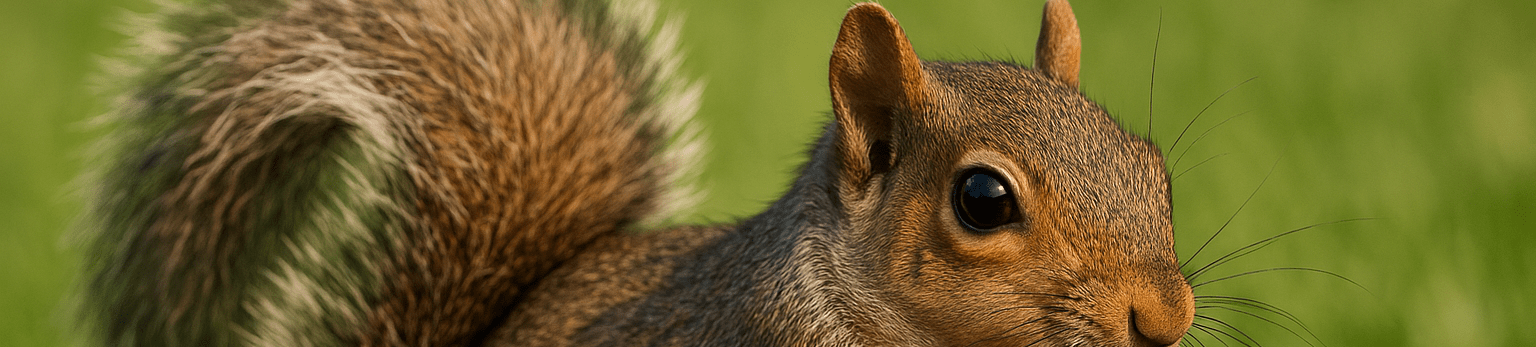
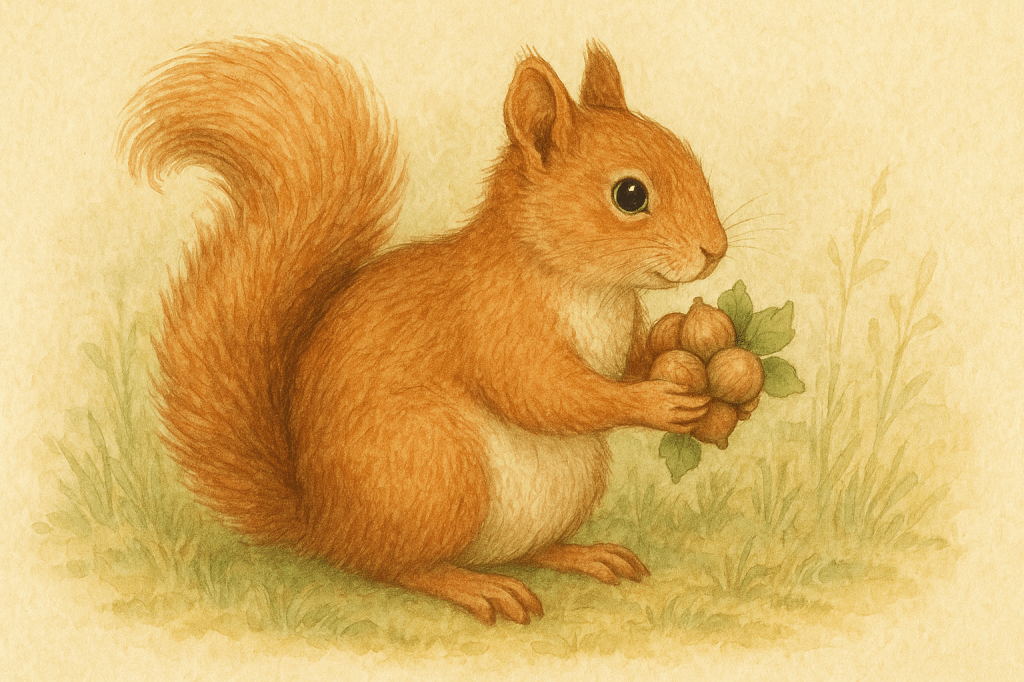
To paraphrase the immortal words of Frank Reynolds (Danny DeVito, It’s Always Sunny in Philadelphia): Can I offer you a nice squirrel in this trying time?

I mean, these first four days of Advent we’ve already covered topics including: bi-stable states, problem children, maybe-surveillance, and um, a eulogy. So yeah, have a squirrel or two. Heck, take three.


Angels In The Squirrels

This morning – there are angels in the squirrels 
And squirrels in the trees
As nuts and leaves drift down in blessing 
From this holy trinity.


(For years, students of philosophy, physics, and IKEA have all known the real question of the universe is: not how many angels can dance on the head of a pin, but how many can fit in one pecan tree.)


Advent, Day 4: On Sacraments & Soup

(Day 4 of this year’s Advent series. Yesterday’s piece was about stillness vs. Mary. And today, I mark an anniversary.)

My friends, you know I am allergic to conclusions. When they show up, they are usually some sort of asymptote. But sometimes this is not the case.

A year ago, walking to work in the early December darkness, I received a phone call from my father. That call was, indeed, a conclusion. There was no ambiguity framing the end – the very particular cessation – of my mother.

We waited until August to hold a memorial. I am deeply grateful to have had nine months for words to form.

Today I leave those words here: not because you knew my mother specifically, but because the main points are ones which I hope might be helpful to anyone who finds themself caught between body and question mark.

That is, the practice of having a body is the only confirmed option we have for experiencing anything; whatever structures of revelation and/or faith and/or oblivion, there is no guarantee of reaching them except going through a body first – however you wish to read that.

Or on my less talkative days: have body, will speculate.

And that is precisely where things sit, this Advent.

One more note: my mother’s memorial was in fact a bit more akin to one of the parties she used to give. My father arranged her artwork around the room, set up spaces for all to sit and talk; a family friend miraculously and generously created a full meal, pimiento cheese and cucumber sandwiches and lemonade and tea and much more; and other friends played music, sang, brought memories, kindnesses, and their own knowledges of pain. I mention this so you have context for the specific references to the setting.


On Sacraments and Soup

(Read in memorial of Leanda Maria Grogan, d. 12/04/2024) 

My friends – 

Thank you all for joining us here, this evening.

As each of you know, one of my mother’s great qualities was that she found rich meaning in preparing spaces for all to come together, to eat, talk, laugh or cry, and share. 

This is something which she did over and over, across changes in time, community and place, throughout her life. 

You may have seen her artwork outside. As pictured in one of the pieces, as a child growing up in the clay hills of Tennessee, she made cakes from earth and rose petals to share with her playmates. 

In her years of professional and teaching work, she put on gallery events and student showcases full of homemade treats and music, where the joyful atmosphere was as much an artist’s craft as anything on the wall.

Throughout my childhood, she made sure to host at least one party every year to bring together families traveling schedules’ divergent paths. 

And in the later years of her life, many of you received to-your-door baked goods or letters from her at times when you might have had need of such things.

Each time – each of these acts – she understood as a sacrament. A sacrament – according to Augustine – is “an outward sign of an inward grace;” or, if you prefer Merriam-Webster, “a sign or symbol of a spiritual reality.” 

Somewhere between inward grace and…grace that encompasses reality, then – we are left with the space in which sacrament-work is performed. 

Of all ways my mother could be remembered or labeled – obviously I am partial to “my mother” but “artist, teacher, friend, spouse, cook” all apply from different mouths – I have come to my own conclusion that “sacrament worker” – while clumsy of diction and unwieldy – is perhaps the most true to the sum of how she sought to live her life.

That is to say, my mother was acutely aware of the intersection between the physical and spiritual realms: between dusting or doing dishes, and Divinity. 

She not just saw, but invited, God – constantly – into the routines and spaces that surrounded her. 

Doing schoolwork in the next room over, I frequently overheard my mother have deeply engrossed conversations, for quite extended periods of time – with God’s Presence. These conversations were usually of such detail and familiarity that I would not have been particularly surprised to hear an answer back. 

The natural overflow of this sort of hands-on approach to inviting God was her deep-seated commitment to inviting others. And although my mother could carry on quite a conversation – all while insisting she was a very quiet person – it is important to note that these invitations were not all of the spoken or mail-box-delivered kind. 

By this I mean: she made many incredible things throughout her life, things that were beautiful and things that were delicious and things that were full of meaning. 

But – through all of her artwork or cooking or writing or teaching – there was really only one thing she was trying to make. 

And that was a space where God could enter the world. 

A space where, for however long that miracle took place – those who wished to, could catch a glimpse of something sacred. 

Something – sacred? 

My friends, please understand. I do not use that word lightly, but I also do not use it, in anything other than completely profound ignorance. 

Unlike the definition of “sacrament” or even “sacrament work” – it would be utterly disingenuous of me to place the bushel basket of definition over it. 

From the glimpses my mother’s work afforded me, therefore, all I can whisper is this. The sacred is – whatever is found in a space, that sends guests out with the beauty or courage, truth or words or silence, to carry them just a bit further along their path than they had thought they could make it, when they arrived. 

In the course of your friendships with her, I do not know what you might consider the last sacrament she left you with. Whatever that might be for each of you, it is now uniquely yours to cherish, and to carry forward as best and however far along your path you are able.

Of those things I have just named, what has stayed with me –  is silence. As my mother’s breathing failed in the last portion of her life, she had no words. 

I do not know what conversations we might have had if she had been able to speak, the last year of her life. As I’ve said, my ignorance is profound. All I can hope, for her and for myself, is that sometimes Grace is best found in the silence left by – simply having no words. And for the end of my mother’s life, I truly have no words. 

Out of my carrying of that silence, then, let me lay out these three truths:

Most things go unfinished. 

Most things go unsaid. 

Most things’ meaning is unknown.

I do not know the meaning of my mother’s life. It feels unfinished, and so much feels unsaid – the obvious things, like the last, “I love you” – and also – the things simply not thought of until there’s no time left to speak. Perhaps you, too, feel the same. 

I also do not know the meaning of her death, other than to try to understand it as a sacrament – and one in which each of us will eventually take part. That is the real meaning of the intersection of the physical and spiritual worlds: that last glimpse of the Divine opening up in this world. The threshold of that sacrament is the space where all of us will arrive as empty-handed guests, from whatever path we’ve been traveling.

Of course, for those of us here tonight, we are all still firmly on the physical side of that threshold. Our hands are still full. We are still doing dishes, and dusting, and maybe having conversations of which only one half can be heard, from the next room over – 

On behalf of whoever’s in that next room, then: please allow me to offer this invite – to remember these three truths. 

First, most things are unfinished; second, most things are unsaid; third, most things’ meaning is unknown.  

That is to say – faith is found in what is unfinished; hope is made on things yet to be said. 

And the meaning of love is, as yet, completely unknown to us who live here in profound ignorance, guests under our bushel baskets as it were – still working, still sharing, still making spaces in the weave of those baskets – where the sacred can come pouring in around us. 

In invitation, then, to my fellow guests, let me close with a poem. 

Twofold Cup

The sacrament of death is twofold –
A cup shared in parts, one sip offered
To the self who departs, 
And the dregs for those who carry still 
The lifeblood mark.

It is the greater rule of love,
This table set – a place for each, 
That all may find – yet –
Their seat by love, which says: 
My brother, my window, my heart – 
My precious unknown other,
My breath apart: 
How would I know your face, 
If not given us to meet
Bound by this table of sacrament? –
As lifelong friends we greet:
So by embrace, this grave hospitality –
We join each in whole to learn 
This untold gift, eternally.


Advent, Day 3: Blessed Are Those/Our Lady Of The Morning

(Day 3 of this year’s Advent series. Yesterday’s piece was about time, beasts, and problem children; today we consider stillness vs. silence vs. surveillance.)

As previously noted, these pieces were written in 2022 as an Advent surprise for my parents. The original piece for today – Blessed Are Those Who Walk Out In Stillness – was also shared on this blog at that time.

Re-reading it now, I note that my understanding has – changed. Obviously I’m deeply interested in not just re-sharing something which some of you (maybe?) have already read; but the nice thing about three years’ passage is that I can invent completely new meanings out of things past-me took pains to set down precisely(ish).

Let us briefly tangent away to context-land. On the mornings when writing occurs, I enact a three-step plan. Step A: catch the 6:28 a.m. bus. Step B: walk 1.1 miles along a precise street in a precise neighborhood in East Austin. Step C: spend the rest of the day helping students in an academic lab and completely coincidentally, writing stuff in the down time. The only part of that which is currently important is Step B: walking. Most of the Advent pieces were thought up during Step B. So when I say:

Blessed are those
Who walk out in stillness – 
Who walk out
In the calm of the day
The early sun
Or afternoon’s scorched hum,
In the byways and alleys,
Shadows and lanes
Or the tracks’ farther lonely side.

What I probably mean is… it was a nice walk to work.

The really odd thing, though, is over the intervening years I somehow convinced myself the piece was actually about silence. “Blessed are those/who walk out in silence –

Nice try, memory.

The first thing is: the street I walk along is not quiet. It’s not busy in the sense of “traffic” – in fact it is blessedly car-less except for a bus every 15 minutes, each direction – but it has: roosters, ducks, donkeys (the small urban farm); squirrels; the sounds of pecans hitting the ground, often just after the sounds of squirrels; dogs; mockingbirds; grackles (if you haven’t heard a grackle, imagine a rusty door hinge gaining sentience and turbo-powered vocal chords); and the high voices of school children and their caretakers, overlaying the deeper sounds of workers and diesel engines arriving early to the aforementioned farm, the tree nursery, road work, and intermittent home demolition/rebuilding projects.

The second thing is, the whole street (and broader neighborhood) is watched by Mary.

I’m not exaggerating. There’s a Mary in almost every yard. Sometimes painted blue and sometimes painted seashell pink or neon green. She shows up on porches, car dashboards, bird baths, upstairs windows, a church (obviously) that has two grottos each with their own Mary. I have this terribly uneasy feeling that there’s a duct tape line down the center of the churchyard demarcating territories in such a setup.

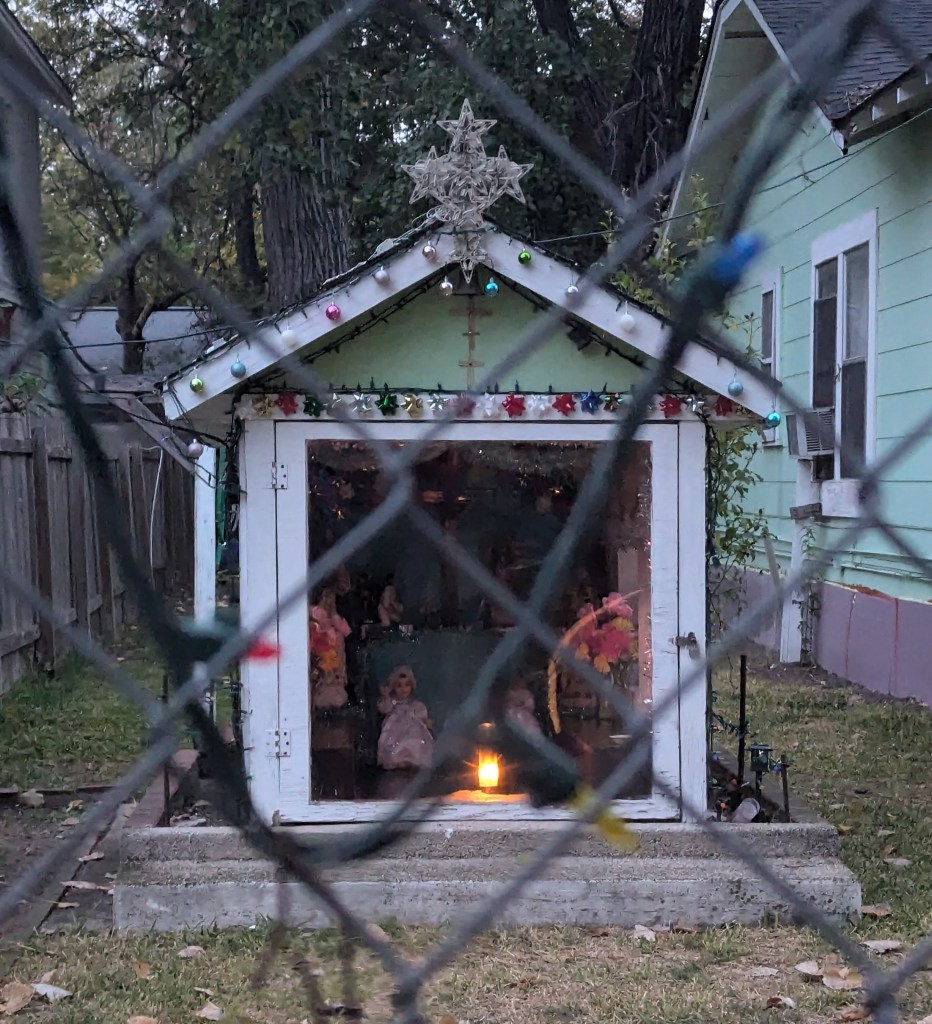
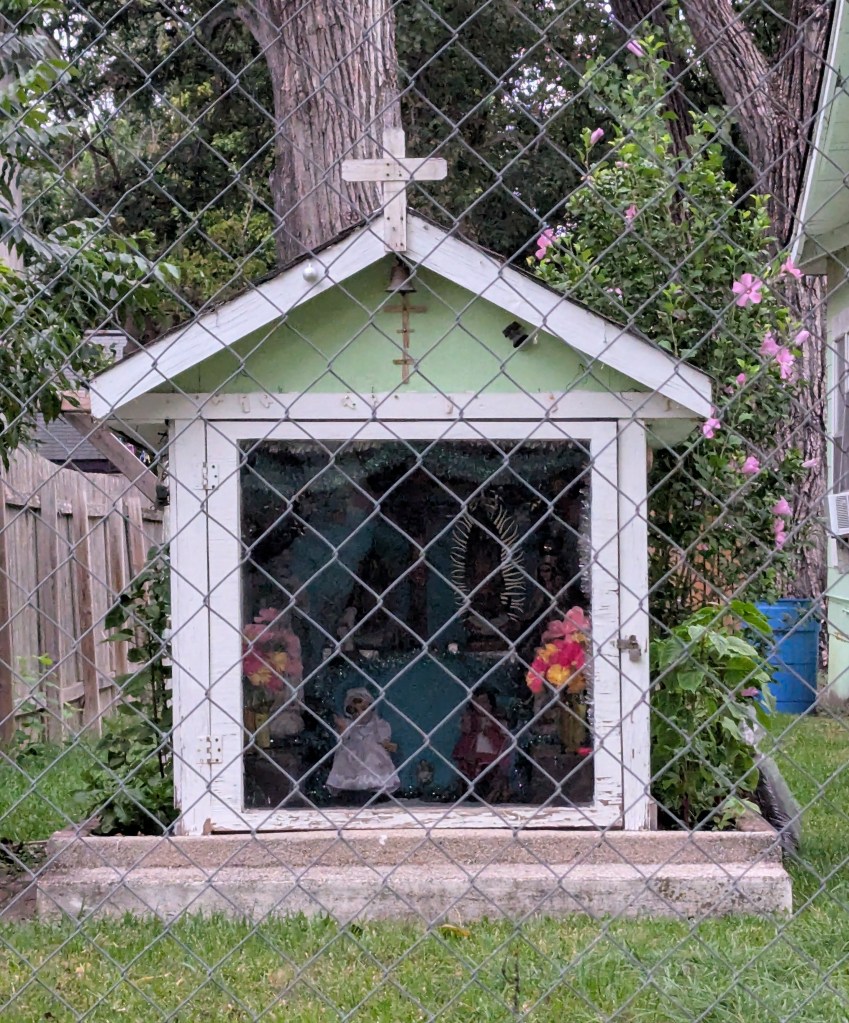
There is even, in my favorite yard, a small shrine. The shrine is about the size of a doghouse, neatly painted with contrasting trim and a shingled roof. It is fully furnished inside, with tiny glowing LED candles, and glassed over so that the shadow of blue can just be seen within.

The overall effect… is not one of surveillance. It’s more – a kind of consistent stillness that accepts and dances through all the movement and sound: not silence, but the counterpoint swell that lifts and carries along each part of the whole.

Well anyway. You may take that as literally or as metaphorically as you like. Enough to say I wrote a piece about it, a different morning.

Our Lady of The Morning

Our Lady of the Morning
Lives in twilight –
White walls, candle glow
Through spotted glass.

Against dark trees she flames 
Like mockingbird –
She trills like silhouette 
In topmost branch, 
Like gift of song on every
Throat’s behalf.

Where donkeys graze, and chickens 
Ask the earth – 
In mounded mould, tangled fence
And sectioned rounds 
Of tree trunk once so strong 
And home to squirrels. 

In the squash and in the seed
In the corn and in the corn
Tortilla, wrapped in foil
Gilt with grease. 

In the hand that gives,
Or holds the gate;
In the workman’s glove
Or child’s bag of books
On parent’s arm;

In the coffee’s scent
Of deepest wake;
Or oil burned
And spilled across
Each road and bridge.

She moves in these
She walks in these
She gifts us these
That we may know her
In the chapel yard’s 
Small holy dwell
Of bright blue paint.

Our Lady of the Morning 
Walks through darkness – 
From night’s far edge 
Towards night drawn down again.

She walks all day 
Beyond white walls, 
In any guise and place –

As candle glow grows back
Towards night-time’s grace.


Advent, Day 2: Looking For Those Who Have Time

(Day 2 of this year’s Advent series. Yesterday’s piece was about leaving space for uncertainty; today we consider time, beasts, and problem children.)


Looking For Those Who Have Time

I’m looking for those
Who have time –

The mythical beasts and angels
Complex
In rest.

Now, in a moment –
No stirring dawn before its rise;
No shadow
From gravity’s sunlit dance
Spun round too soon;

And the breath rises out
And the cells turn their rhyme
For the heart of the blood
Should be peace. 


You have heard, I am sure, of the phrase “problem child.” 

It is not exactly a phrase any parent uses. No, it is the phrase other people use when discussing a specific family dynamic at that point in the gossip session where complete candor has melted unctuously into its juiciest, densest center.

No names are ever specified. Instead: “Oh, yes, that’s the problem child.” (It is possible, given the context, that no names ever need be attached because everyone present has…already read Calvin and Hobbes, as it were.)

My point here is that the “problem child” (that tiny entity rendered transcendent by lack of name) generally serves as the perfect raison d’être for any problem being discussed. This little creature becomes the hinge for – everything. 

Under The Sign Of The Problem Child

Now. Since I am happily childless, let us consider this in the context of things I care about. The above piece, “Looking For Those Who Have Time,” has been a bit of a “problem child” since its inception. It’s not even the whole piece; my choking instinct is specifically triggered by the last two lines (“For the heart of the blood/Should be peace.”), every single read-through. 

And what am I to do about that? Every time I try to change it – through tiniest surgery or blazing keyboard strokes – the whole thing collapses. It does not want to change. 

But I can’t get over the deafening triteness of “peace” as the conclusion to – all that comes before. Really? Really? –  

Well, no, not really. I lately realized that the problem isn’t the last two lines per se. Instead, the last two lines are linked to the actual core of the piece: “The mythical beasts and angels/Complex/In rest.” 

I love that phrase. It’s the opposite of my choke response, every time I read it. 

That line is the hinge, the center about which everything else swings. (I do not subscribe to the “kill your darlings” philosophy, that’s how you end up with Othello.)  

So after everything, finally, I left – everything. Whole, as-is, intact, nothing changed. I still wince every time I read the last part and then end up staring miserably at my poor mythical beasts and angels, happy in their complex rest and serenely not giving me any ideas. 

Creature Feature

It’s worth noting here that ever since I was a kid (not a problem child, you can’t be “the” problem child if you’re also “an only child”) – I’ve loved Creatures. I was firmly on the side of the Harpies, the Sphinx, and Scylla and Charybdis (which are technically two sides at once?) – I was furious with Heracles/Hercules for ecological vandalism and accelerating multiple species along the endangered-to-extinct pipeline; and I hate many versions of Beauty and the Beast because…who the hell wouldn’t stay a Beast? Talk about de-evolution. 

When Suddenly, A Borges Appeared

Obviously, then, given this and my elsewhere-noted penchant for Borges, I double-love The Book of Imaginary Beings. It is a collection of creatures, across cultures and time, who are defined by impossibility.

The interesting thing about Borges is that he often does this shell-game effect with the real and the unreal, symbol and source. He conflates the library and the labyrinth. 

He habitually writes of encyclopedias with bogus entries (Tlön, Uqbar, Orbis Tertius); words that contain language and the end of language (The Aleph); fictitious writers of books which are then alluded to by other, equally fictitious writers – set in entirely different stories (notably The Secret Miracle’s Jaromir Hladík (which I write about here) is mentioned by a (nonexistent) theologian in Three Versions of Judas). 

The translator’s note to my edition of Imaginary Beings (trans. by Andrew Hurley) neatly sums this effect: 

…the creatures…are stitched together, like Dr. Frankenstein’s creation, out of the parts of real creatures, but the whole is a whole that is impossible, ‘fantastic,’ never seen in nature.

And, immediately following, the linked observation that the act of detailing these “impossible” beasts effects that most alchemical of transformations, tipping them into the possible:

…This fantastic encyclopedia, like that earlier alphabetized universe, has ‘penetrated’ our own: the imaginary beings it chronicles are creatures we have lived with and think of as ‘normal’ aspects of our world – if not our real world, then the inner world of our fantasies and dreams and fears.” 

That is to say, refer to a fiction often enough, and a sort of shell of “nonfiction” will eventually form, by virtue of its inclusion in many nonfictional things. The opposite, of course, is also true: many facts have an entire apparatus of accepted non-facts (if not outright lies) orbiting their unseen nucleus.  

It is these shells that Borges is most adept at swapping around, spinning in ever-more-complex patterns of image and idea, before letting them come to rest – tantalizingly still (tantalizingly identical) – on the table of our contemplation. Pick one. 

I recently picked one. 

That is to say: “Looking For Those Who Have Time” was written in 2022, part of a series of Advent poems I shoveled into envelopes and mailed off to my parents throughout December. 

Yet I recently looked at it again, looked differently at its real/unreal shell. As happens when one turns over a shell, I found something that was – part of the same game, yes, but utterly different. An Imaginary Being. 

Three Winged

A bird’s wing on
Concrete. Fanned
Like unmatched angels’ un-
Steady 

Beat –

Later: mesquite leaves’ perfect
Flared pair, green and neat.

Together, these make trinity

For some rare
New beast;

Three-winged,
Singing 
And

            afloat        

Where 

Bodies known

End. 

Rare New Beast: Bodies, Time, Peace

It isn’t really as neat as the first shell it wore. I’m not really as neat about many things these days, insofar as my ability to say what anything means has vanished even further away than it once was. However:

It seems the idea of time – having it, not having it, losing or savoring it – is always tied to bodies. 

They may be mythical, they may be real; composite, Frankensteined, perfect, failing, falling, floating, difficult, or draining. But it is through bodies that time is had: bodies are the sense by which time is perceived. We cup our hands, so time can pour through. 

Bodies are, of course, eventually lost to time – or perhaps bodies eventually become overwhelmed with their sense of time. 

Or perhaps the more one thinks about time, looks and tastes and pokes at it (as it were) – the idea of using a body to experience time becomes stranger and stranger: 

…This fantastic encyclopedia, like that earlier alphabetized universe, has ‘penetrated’ our own: the imaginary beings it chronicles are creatures we have lived with and think of as ‘normal’ aspects of our world…” 

Bodies, time, peace; each of these are reality’s “problem children,” the imaginary beings, the hinges, the raisons d’être for everything else: tiny entities rendered transcendent by lack of better names. They are each the symbol and the source: we cup our hands, so that they can pour through. 

It’s certainly a strange shell game to play. At least you’re guaranteed something is under the shell, figuratively speaking: finding “peace” rather than “the piece you were looking for” is still…pretty good. 

Now after all that, I’m off to read Calvin and Hobbes. In case I need backup theories for handling any more “problem children” – imaginary or otherwise. 


Citations
Borges, Jorge Luis, and Margarita Guerrero. The Book of Imaginary Beings. Translated by Andrew Hurley. Illustrated by Peter Sís. New York: Penguin Books, 2006.


Advent, Day 1: No Desert, This

No desert, this:
No time of giving up
Nor letting go – 
Nor gathering in
A harvest,
Rich or spare.

Now is time
For the unresolved – 
By wander or by call,
Wait or weight not moved
By best intent.

Now is time
When birds and stones cry out –
Though yet unknown;

In wheeling winds, 
In the unmown place,
Their gifts are building
Growing towards
Lengthening towards
Some flight of season –

Rare.


My friends –

Once again, the year has washed us ashore – here.

Where?

One of the two great “question mark” spaces built into the liturgical year; those spaces which, if we are wandering them correctly, offer us not a single guarantee of what we are wandering towards.

I greatly prefer Advent when I do not know what I am wandering towards.

There is, you see, a terrible temptation to fixate on cute little manger scenes this time of year. I do not precisely object to the manger scenes per se – I had an early habit of stealing Baby Jesus from pre-natal residence in my mother’s sock drawer – but hear me out: convenient crèches do not pop up anywhere else in life, at any other time, to form a conclusive little “point to all this.”

My mother passed away last December, at the beginning of Advent. A Reverse-Advent, if you will.

I don’t know what she thought about the fact of her passing, because she effectively ceased to speak months prior. I still don’t know what I think about it, either: there is some sort of terrible, constant gratitude, and the strange wonder one has for death. There is, of course, also a steady background drip-drip-dripping of random little deadweight thoughts and memories on any given day.

In the spillage, the crèche becomes akin to the classic perception trick known as Rubin’s vase: a black-and-white image which is in fact two images, depending on your focus. Birth, death: a bloody Mary possibly needing stitches, and definitely needing a more hygienic environment than a goddamn bed of straw. Put the angel on the roof, folks, right up there next to the star: I guarantee Sister Death (as a later St. Francis would name her) was much closer to the crib.

And yet – Sister Death, too, that figure in black and white, becomes vase and face at the same time, helping to birth –

What?

The classic Advent calendar, of course, involves opening doors. Theoretically one does this to get at the secrets hidden behind each door, but the promise of invariably-stale milk chocolate (they never, ever make them with dark chocolate) is a ridiculous effacement of the accidental symbolism here.

A door, figuratively speaking, is the original Rubin’s vase – a space that gives and takes, welcomes and sends off. It is bi-stable. It is unresolved. Its function is to remain unresolved. It is a gift of uncertainty.

Lord, take this certainty. I wish I didn’t know exactly what I was wandering towards, because of course I do in at least one sense. And I wish I knew what to do with the steady drip of things that won’t change; pain, and the costly price of its few antidotes.

Open the door, leave it open. (Leave the milk chocolate too.) Don’t bother looking for a desert beyond; this is no site of personal transformation, no vision quest or pilgrimage.

It is a practice of leaving space for versions of yourself, myself – maybe even Mary, Sister Death, and many others; versions that might look quite different from the faces framed by our daily lives and concerns.

And as we each move forward into this Advent – as, each day, I post a piece here – for now let’s just start with that lack of certainty. No desert, this: enough to say, “What is it?” and wonder (wander) forward, uncertainly, between the lines of black and white on either side.


Tiresias Struck Through

As with most myths, the story of Tiresias exists in multiple versions that often cheerfully contradict and/or overlap each other. Their Wikipedia page makes for quite entertaining reading.

The relevant, reasonably stable thread is this: Tiresias was a prophet who existed as both male and female for different portions of life, either as gift or grievance from the usual Greek kick-line of gods. Given the strict Ancient Greek categorization of women, the fact that everyone seemed to just roll with this is sort of hilarious, in a what-are-y’all-not-saying kind of way – or so I’ve always thought.

At any rate, Tiresias’ sex-change is usually tied to their act of striking a pair of snakes engaged in, um, co-slithering behavior. You heard it here, kids – gender panic comes back to bite ‘ya.


(Also, if explicit language is not for you – consider this the Universe releasing a scurry of metaphoric ADD squirrels to distract you from the rest of the post.)


1.
I’m a prophet not a whore but:
But for –

For a while lines blurred. Hera
And He two snakes I struck through 
Politely, as one does with Gods.

As a prophet and a whore I can’t remember which
Happened before – 

Strike or – form –

2.
I’m a prophet not a whore but for
A while all lines blurred yet

The really
Ridiculous thing is in a place like
Ancient Greece 

Where I should sit at home and comb
Fleece –

How the hell did I get to
(Fuck around)
(Fill my)(Seek my fill)
(Seed my -)(Sex)(O)(So full)
See the world

As a woman? –

3.
I’m a prophet not a whore and for
A while all lines blurred no
Words

Fit my state. No parthenos to gynē
Pipeline, nor hetaira, pallakē, pornē
To thēly
To discuss, Aristotle only touched 
My neutered form 

“In some species the female is more
Aggressive 
Than the male”

(Not-neutered-I can say I touched 
As blind
On more
Than Aristotle –
Many times -)

4. 
I’m a prophet not a whore but still – for

A while all lines blurred all all
(Inside with need all seed all) 
That other form – I –

All grain on threshing floors, oil
Slick with first press stores, wine’s heady
Heavy gush down to the blind-colored sea 

Now hush I – voiced to rise – as women’s threads
Stretch 
On spindled tides’ 
Retreat-and-follow sighs –

The sea with tides that form away
Land’s substance-shores and hold
No space no lines blurred all 
By time but what times all unwinds –
All I unblind –
(Rise, fill) find –

Other form I now find whore more

Inside lines I –
That other form, inside my lines – I,

All lines blurred, I find. 

5.
I’m a prophet not a whore but did

My substance receive form, did
I birthing-warm-and-score my womb
For two, four, none or more? Where
(Hold, skin, no-lines-more – give -)

Are those pieces 
(Where was I -)

6.
I’m a prophet not a whore but for
A while, a time, all lines
Could not hold me. I blurred.

When (I) saw those snakes again 

Did (I) hesitate?

7. 
I’m a prophet not a whore but for a while –
Sacred and profane or all such tame
Concepts as men
Give form to –

Substance sees differently. 
All different sides, all-alive all un-
Lined. 

∞.
(I’m a prophet, perhaps
More, or no more – un
Defined -)

I’m a prophet, and blind. All
Lines blurred 
A long time 
Ago, or too far 
To future-find –

Forms’ unsteady state.
All things happened then or when and
I, I (blurred lines, blind, reception site)
Receive, in my substance –

Opened soft as unwound wool 
‘Til Gods take up to spin.
Change, then, many times –
Wrap and rise, twist both, all same
Time 
(Prophet-whore-truth-blind)

Twist-combine the wool to know
Best, its kind (blurs lined) now –

Now all-twined, as snakes 
Just struck –
Just un-lined –
From-about all form Divine. 


Silver-Pawed I

“…So frame my words in double and my form in all that’s vain
Kisses kill contentment and a spark will fan the flame
Legends grow from alibis, springtime turns to grain
Beasts turn to fantasy when wildness you tame.”

For all you fellow shape-shifting beings: if you seek some trick-talking, boundary-slipping delight (while you contemplate your next form or fall from grace) – here’s a tune to start your path today.


Silver-pawed I, silver as the flames of flowers
Silver-tongued why to the ways of virtue-spending hours
Silk over fur and silver for the purse
As my form changes shape so my fortunes will reverse


Flawed like a fruit with the one side seen
Fleet on the fleeing nights, full moon over green
Green under bark fuels smoke from the fire
Gold in my eyes rolls the chances of desire


So frame my words in double and my form in all that’s vain
Kisses kill contentment and a spark will fan the flame
Legends grow from alibis, springtime turns to grain
Beasts turn to fantasy when wildness you tame


Seek what you swallow and catch what you hold
Empty find the bed once the night is grown old
Full weighed your heart and futile is the chase
Me you thought you owned was just another face


Just a pretty skin for the virtue-loving hours
Pretty ways to sin while I wait for better flowers
Dancing through the holy words and laughing in the shrine
Tricks under the tables stealing seconds from the time


Time will fold the forests as the great trees fold to fell
Beasts who hold the wildness will learn to hide too well
I might hide my beauty but my faces’ marks show through
Lose the holy thieving tease and lose your stories too


So frame my words in double and my form in all that’s vain
Kisses kill contentment and a spark will fan the flame
Legends grow from alibis, springtime turns to grain
Beasts turn to fantasy when wildness you tame


Silver-pawed I, silver as the flames of flowers
Silver-tongued why to the ways of virtue-spending hours
Silk over fur and silver for the purse
As my form changes shape so my fortunes will reverse


Beyond the Timeline: For Love and Dead Doves

Those years you died –

I tried to fill my days
With greed.

I have never been able to tell if I love. The word defines such a definite state, a checklist or epic, a dance or a look. All these pieces and more are scattered like crumbs or clues across things humans make. I also, it seems, cannot find grief. 

Rather, I grieve all the time for many things: cicadas with the wings ripped off; smashed frogs; the sky; children, learning things; people who die in winter, slipping under before spring melts the river-ice. I think of grief as the sounds of water under ice, in a winter wood: soft, mostly, always there. Step wrong, and – it wells through blackly, tannin-stewed and rich as oil, twice as slick across the skin and staining, staining strong. 

Senses all deprived, it seemed,

Of reason.

(What a season, drenched
Across springs -)

It might have made more sense had I learned in winter, but it was already spring. Surrounded by an apocalypse of green, the person I should love the most was facing transition, transformation, into an object of grief. Calmly, I asked questions and made suggestions. 

I recommended books that did not help. I listened, and sent a poem that reminded me of a shared conversation, “Bird Among Branches.” It did not land well. So I didn’t send more, too unsure of what other uncertainties and motifs might bleed through to infect further.

I listened each week to the monotony of illness, the claustrophobia and the small slipping of things that had held firm for years. I tried to feel more than detached. Sometimes I was slightly frustrated. Many times I was tired – not in any way fixable by rest. Like the numbness of damaged skin, or the aftermath of a burned mouth, my affection lost flavor, and no other sense took over. 

I tried to write, memories mostly. “Things To Not Talk About” and “Marginalia” and “Gravity Gave Up On A Lovely Spring Day” are from around that time. The process of drafting and editing furthered my disassociation, except for the times tears came. I felt better when they did, as they meant I was not dead. 

Time, now, leaked
An all-seamed wrong urge:
Scrolls of clocks unraveling still – so spilled –
In fury knit the score –

When I was not failing to grieve, I read. I had discovered danmei novels, the works of MXTX and a few others. While waiting for sequential library holds, I scrolled Tumblr for fulfillment, and soon clicked the fan fiction multiverse of AO3. Then my nerves returned.

I bled pages
For more. Killed, each night,
By light-locked page – return, trust only
Things that burn
To intoxicate: all yearnings formed
Perfect-disgraced
And rampant.

AO3 is, according to its main webpage, “a fan-created, fan-run, nonprofit, noncommercial archive for transformative fanworks, like fanfiction, fanart, fan videos, and podfic.” “Transformative fanworks” is both precise and accurate: to wit, fan-written works expanding or subverting or exploding the stories of other creators’ characters. Popular fandoms (Marvel or Pokemon) have thousands of pieces. Some are terribly written; some are unfinished. More are well – or even brilliantly – written. Regardless of flavor, however, most are some form of smut. 

Did the characters love or hate, or never meet? Were they obstructed by circumstance, or their own personalities; did they live in different times, did they lose their memories, did they die. (If so – did they kill each other? Was anyone dismembered or eaten?) 

Did their eyes meet once, did they duel, did they share dessert or wine or steamed buns or aphrodisiacs or hallucinogens or (specific mostly to a subset of the MXTX fandom) Heavenly Demon blood? 

Whatever the character pairing, whatever the canon states: a different version exists, over and over and over. Roll the combinations, and see how many times a thing can happen. See the impossible, and insane, profane (so much profane); see healing. Sweat and tears and … other fluids, more Heavenly Demon blood (conveniently abbreviated HDB at this point, it has its own archival tags – many archival tags exist, some worth more than the story itself. Among the most iconic is Dead Dove: Do Not Eat, drawn from an Arrested Development episode) – see comfort, and at least eight “The Way It Should Have Happened” moments. 

See the next story, and the next. Contradictions are resolved and resurrected and rejoiced in; laughter and drama and tragedy, but all characters are alive, will be alive, across infinite try-agains. 

Written pairings ease the pinned-wide shove
Of spring’s disease with: this too
Is also fine.

AO3 does not have a library wait time. It lives inside my phone, and is free. For anticipated internet outages, favorite pieces can even be downloaded. It can follow me everywhere, and it did. I devoted hours, in all circumstances and environments, to searching for good pieces amid the infinite scroll. From the notorious tag Dead Dove: Do Not Eat; to, I Will Go Down With This Ship (through Bad Prep, Mildly Dubious Consent, Canon-Typical Violence, Demonic Courting Rituals, Hopeful Ending, Unreliable Narrator, The Many Creative Uses for Heavenly Demon Blood, and…you know what, never mind) –   I did not need to write anything at all. Everything had already been written. Everything.

When I was unable to read – due to, say, being at work – I could still speculate. In my head I constructed my own versions, usually even more smut-based than the smut they were based on. I wanted to try all eight “The Way It Should Have Happened”-s, at least in theory.  I wanted dessert and wine and steamed buns, maybe aphrodisiacs, pass on the hallucinogens, and – with very specific negotiated consents in place – HDB. 

I tried to fill my days
With greed. Shape, tooth and quill, or

Softer still, those blanket-covered skills

For sharing;

Staring by feel, and tasting eyes,
Hearing hard the tangled star
Jasmine’s rise, each night,
Under scent-swelled sky.

More importantly, I wanted all the ways anything could happen. I wanted to know I could try again, try anything, anyone could try anything again. If you lose someone, even yourself, in this life – there’s another, out beyond the canon timeline. All three of MXTX’s main couples have at least one partner who has died – sometimes multiple times.

(Try again some other life-
Time, Daoist states – red threads
Bind fate.)

It turns out it’s easier to love someone when they are dead. I feel love, now, at least part of the time. 

Around mid-winter, speaking ceased. Silence was a product of disease, of fatigue. For weeks words had been only minutes, the hurry to say “I love you” and the uncertainty of receipt. 

You – I dreamed – sometimes cried.

You, I saw,

I saw and –

Nothing helped. No self
Seemed left, but the pieces
Joy left, untouched.

In May, more apocalypse of green: a message. I traveled in June, and finally wrote. 

It is a difficult thing to transmute suffering into a piece. Every person has a right to their own suffering. It is unique to them, and precious, and utterly beyond Dead Dove warnings.

Yet this person I should love most – I saw some of their moments and I stole them, mined, made them mine, overlaid. I did not ask them for pictures because I know they would not have wanted any taken. But I wrote down all the words I thought to capture, notes while they slept and some while they were awake. I took skin, and the hollows where skin should have been; I took a few breaths, hard won. I took other things, without even words to match.  

For the day I meet Ammit – for the other half of the scale against my heart: I know I cried some of the time while writing. I tried not to take lightly – just the things I found irreplaceable, a careful thief. And I tried to keep my mind clear. Almost no smut. Very little, at least. 

The grief did hit around October. It was that terrible place where I know that person didn’t want to be, didn’t want to slip under – I wish stubbornness was all it took. 

(Such memory, I could bite
And maul the shape. Sometimes
I screamed at night,
Against white tiles.)

Winter again. At least this time it made sense. 

You -.

I wrote cards that day.

Sent, sent
Mailed away.

Changing sky
Iris binds, again.

It returns to this: I grieve all the time for many things – cicadas with the wings ripped off, smashed frogs; the sky; children, learning things; people who die in winter, slipping under before spring melts the river-ice. 

I think of grief as the sounds of water under ice, in a winter wood: soft, mostly, always there. And I think of crumbs and clues, scattered like crocuses in the snow. I think of the strange-starred tracks of birds, leading to the lift-off question of – somewhere else. I think of trees’ dark bark, the tannins in the leaf, the leaf before it left the tree, the tree before it framed shadows on the snow and sky. 

All of these things seem to be such an indefinite state: a lost checklist or a half-dreamed epic, a child’s dance. A look. It seems nothing is definite, certainly not something as crucial as the twinned shapes of love and grief. Their focus is not static, and neither should they be. They are held, given, mined, stolen, shared. I am always stealing or mining mine, it seems, or reshaping it into some new form to meet the surge of spring after ice melts. 

Re-shaped now, I 
And flicked my tongue to right 
The errored trees in me: a forest, 
And all space. Now,
Embrace
The scaled flight of bees, see
Cross-pollinate: the crave of
All things made and making still. Skin, 
My skin, and trees: no more
To scorch the burning page, but grow
Changing things –
This too:
Also fine.

(I’ll find 
What all you missed
And miss still) –

For now, I’ll not talk
To Eve: her bite from me 
She took.

I’ll wrap all things
In red –

(Red, for love and stubbornness
And bites took freely: the pleasure
To prick and permeate, strange bliss, or
Learn anew -)

And recreate, some day
A page that burns 

For you.


Music Box (Hope You’re Haunted)

As we continue through spooky season, here’s my hope that you and yours are haunted by only the nicest chills, tricks and treats! And a song to go with those drafty midnight hours and misted October mornings.


Notes In The Margins

Some stories have a way of unfolding more the more you listen, should you take the time to. And some stories acquire meanings from each person who listens closely. I hope you, too, find time to make notes in the margins of the stories you cherish.